North and South Korea: why there are two, why their war never ended, and why 2026 turned dangerous
In September a North Korean mine wounded three South Korean soldiers inside the DMZ, and Pyongyang refused even to discuss where the border runs. Seventy-three years after the fighting stopped, the two Koreas have no peace, no talks, and a growing North Korean arsenal.
This story is still unfolding. It is written from what was public up to 27 November 2026. As events move we publish a new version and mark what changed.
One explosion in the DMZ shows why, 73 years after the fighting stopped, the two Koreas still can't agree where one ends and the other begins.
On 21 September 2026 a landmine went off inside the , the buffer strip between North and South Korea. Three South Korean soldiers were wounded.
On 5 October South Korea's military published its findings. It said the mine was North Korean, encased in resin, and planted about 10 metres south of the , the border itself.
, Kim Jong Un's sister and the regime's voice on the South, called this a “groundless conclusion”. On 6 October North Korea's foreign ministry called the blast a “self-staged farce”, in the words of a machine translation of the Korean report.
It warned of “immediate and powerful countermeasures” if South Korean troops moved onto its territory “by even 1 millimeter”. And it said it would not discuss its “military sovereignty” with “an adversary state under any circumstances”.
By the numbers
The border in 2026
~10 mSouth of the border line, where the mine was planted (Seoul's finding)
3South Korean soldiers wounded, 21 Sep 2026
9 → ~50North Korean line crossings: all of 2024 vs 2026 to early October (Seoul)
~960,000Mines the North has laid in the DMZ area since 2024 (Seoul)
✓Answered: What happened in 2026 to turn a cold standoff into a dangerous one?
The real dispute is older than the mine: nobody agrees exactly where the border runs.
Days before, South Korea's unification minister, , had proposed talks with the North about the line. The lines “as measured by the South and North and the UNC are all different,” he said. “If this is not resolved, a similar accident could happen at any time.”
At a briefing on 5 October, Seoul said North Korean troops had crossed the line about 50 times so far in 2026, up from 9 in all of 2024. South Korean soldiers answer with warning shots and broadcasts. Military officials told South Korea's parliament that the North has laid about 960,000 mines in the DMZ area since 2024.
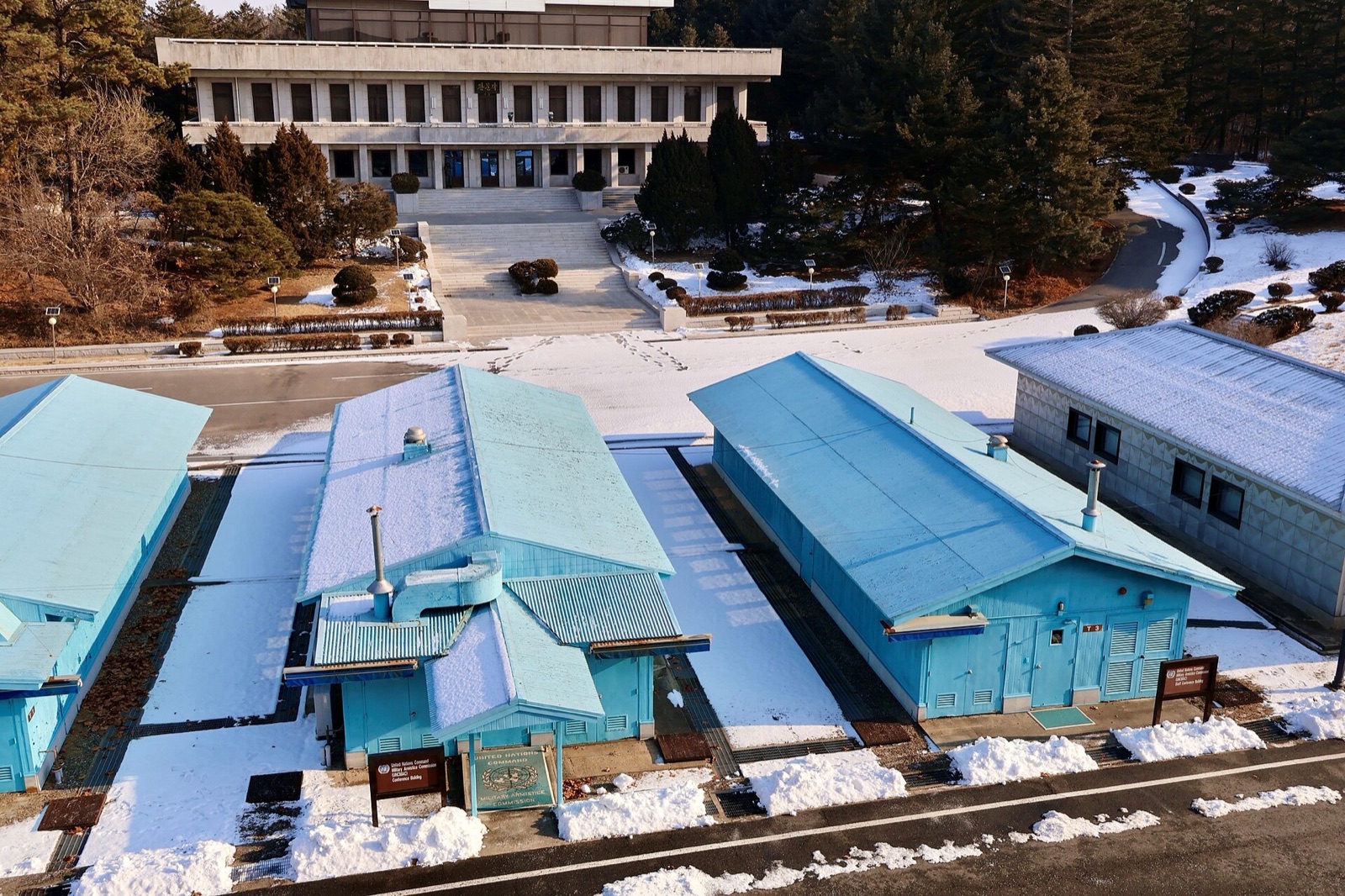
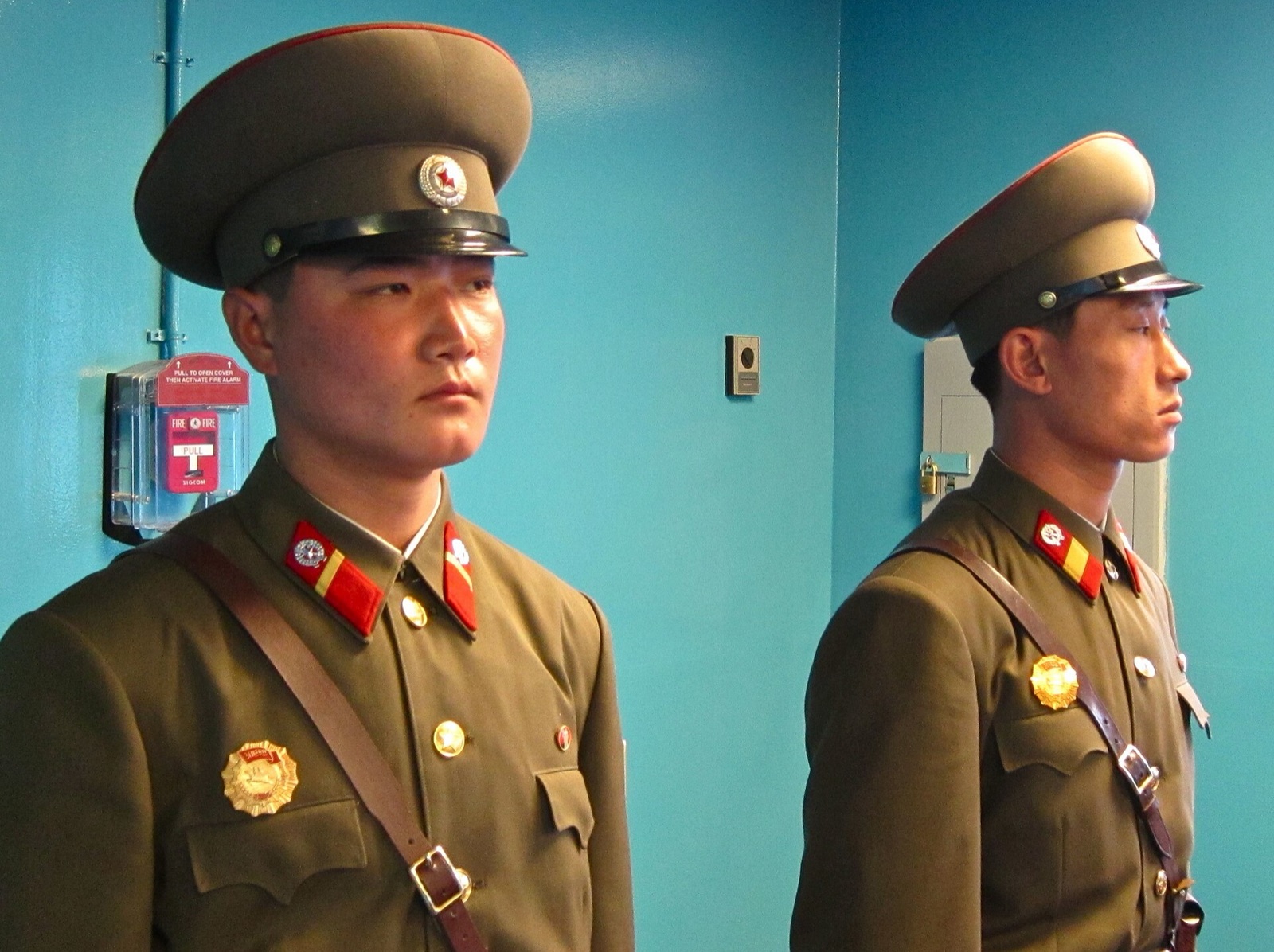
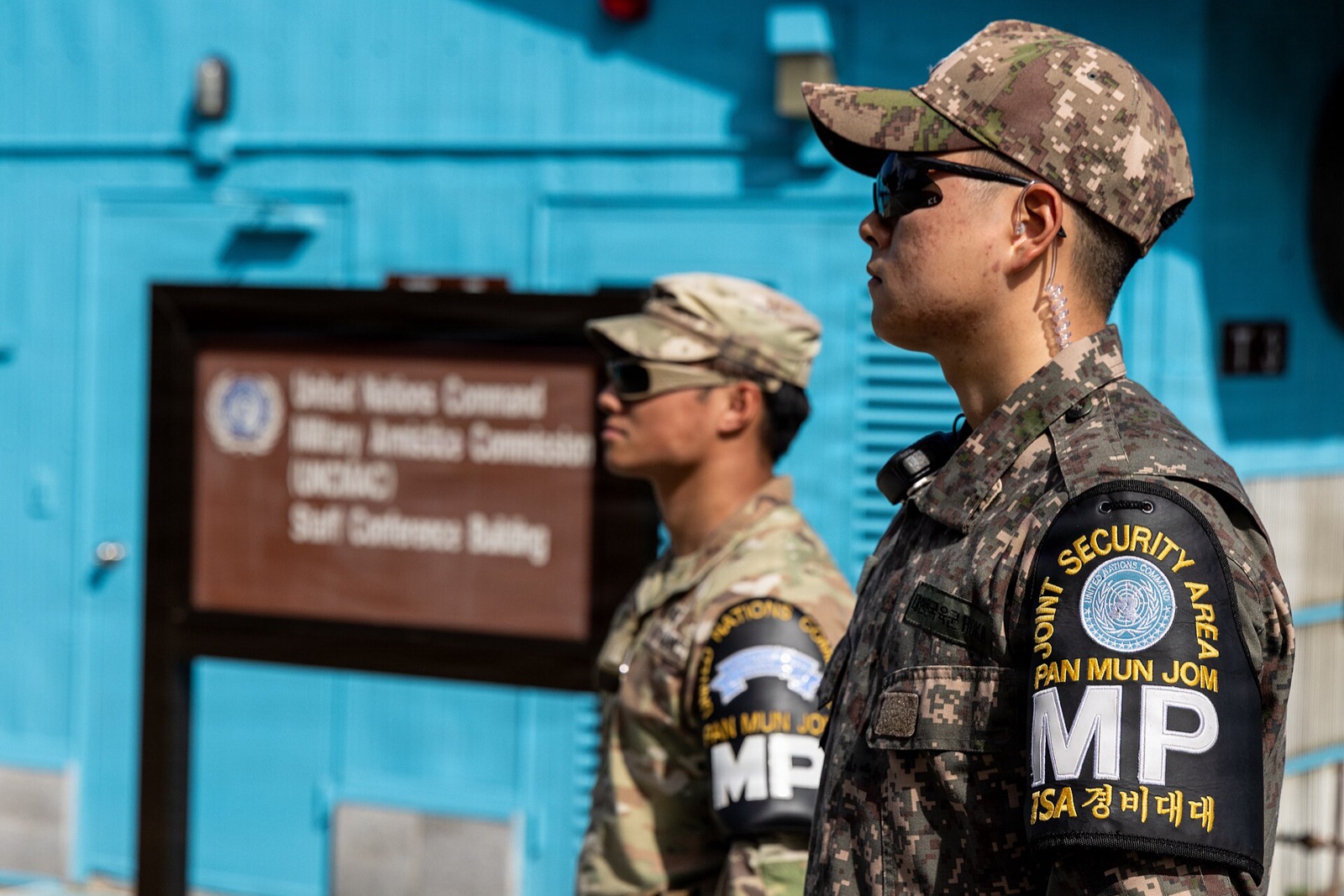
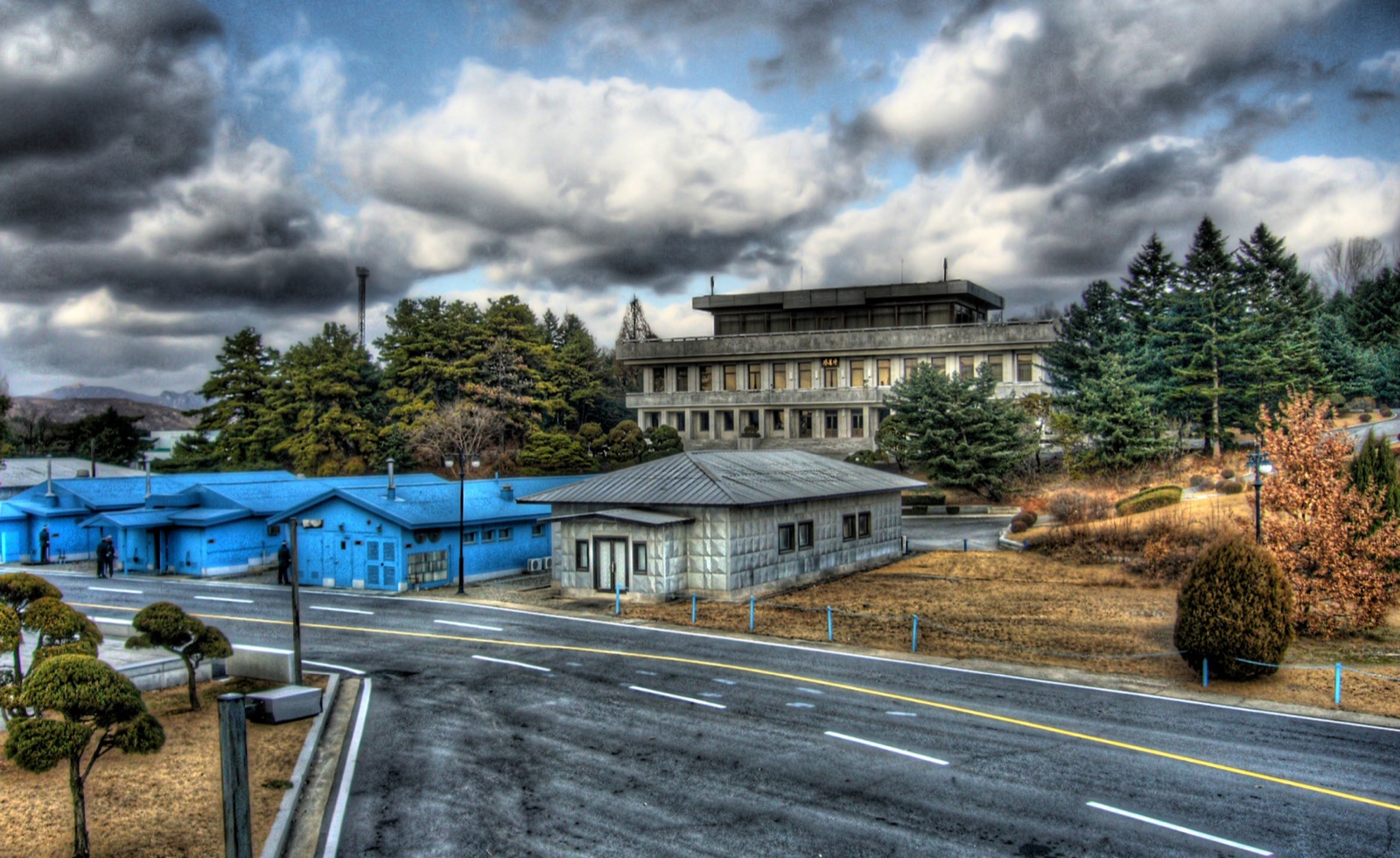
Panmunjom, the one place on the line where the two sides' soldiers stand within sight of each other.
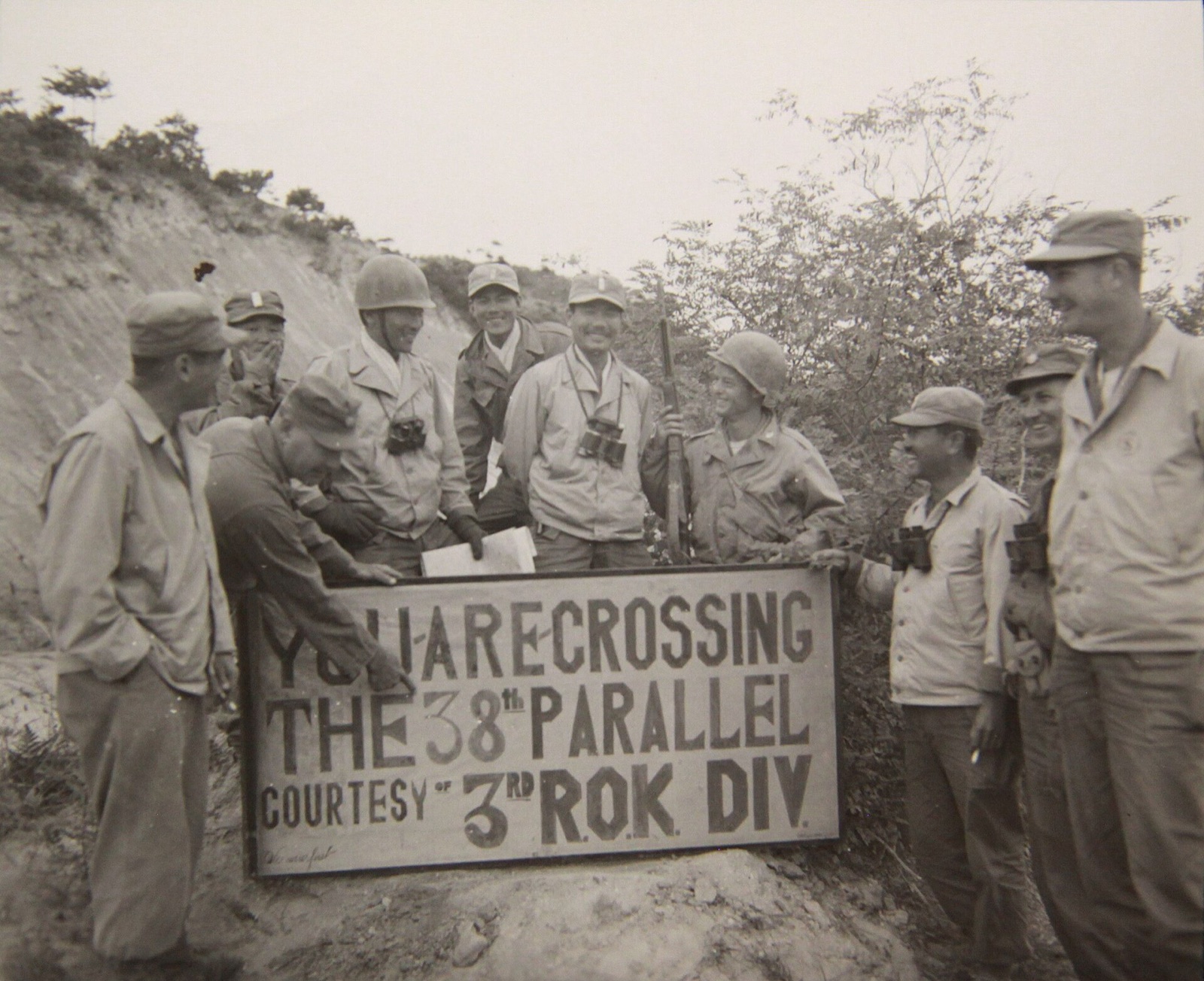
That line was fixed by generals in 1953, on top of a line drawn by two American officers in a single night in 1945. To understand the mine, you need the story of the line.
Two months on, Washington's courtship has stalled and Pyongyang is building more bombs.
On 19 November left a summit in Shenzhen, China, without meeting . Days earlier he had said a meeting was possible, and “up to President Xi”.
On 25 November Kim toured plants that make nuclear material. He called his country's nuclear status an “irreversible reality” and urged deploying low-yield battlefield nuclear weapons.
This story explains how the peninsula got here: why there are two Koreas, why their war never formally ended, how far apart they are, who backs whom, and what changed in 2026.
✓Answered: Will Trump and Kim meet again, and on what terms?
02A line drawn overnight
Why Korea was split in 1945, and why a temporary line became two rival states.
Before it was two countries, Korea was a Japanese colony for 35 years.
Japan annexed Korea in 1910 and ruled it as a colony until its defeat in 1945. South Korea's position is that the annexation treaty was void from the start, because Korea's emperor refused to sign it.
Korea was liberated on 15 August 1945, when Japan surrendered. The question was who would take the surrender of Japan's troops there. Soviet forces were already fighting in the north. American forces could not reach far into Korea quickly.
✓Answered: Why are there two Koreas at all, when neither side ever accepted the split?
Two American officers picked the 38th parallel in a single night, using a National Geographic map.
By Rusk's own account, written in 1950 and “based on memory”, it was on the night of 10–11 August 1945 that a US government committee asked two officers, Colonel Charles Bonesteel and , to propose a dividing line.
We recommended the 38th parallel even though it was further north than could be realistically reached…
— Dean Rusk, memorandum of 12 July 1950
The aim, Rusk wrote, was to put the capital, Seoul, in the American zone. He was “somewhat surprised” when the Soviets accepted. In a later memoir he said they used a National Geographic map, and admitted: “Neither Tic nor I was a Korea expert.”
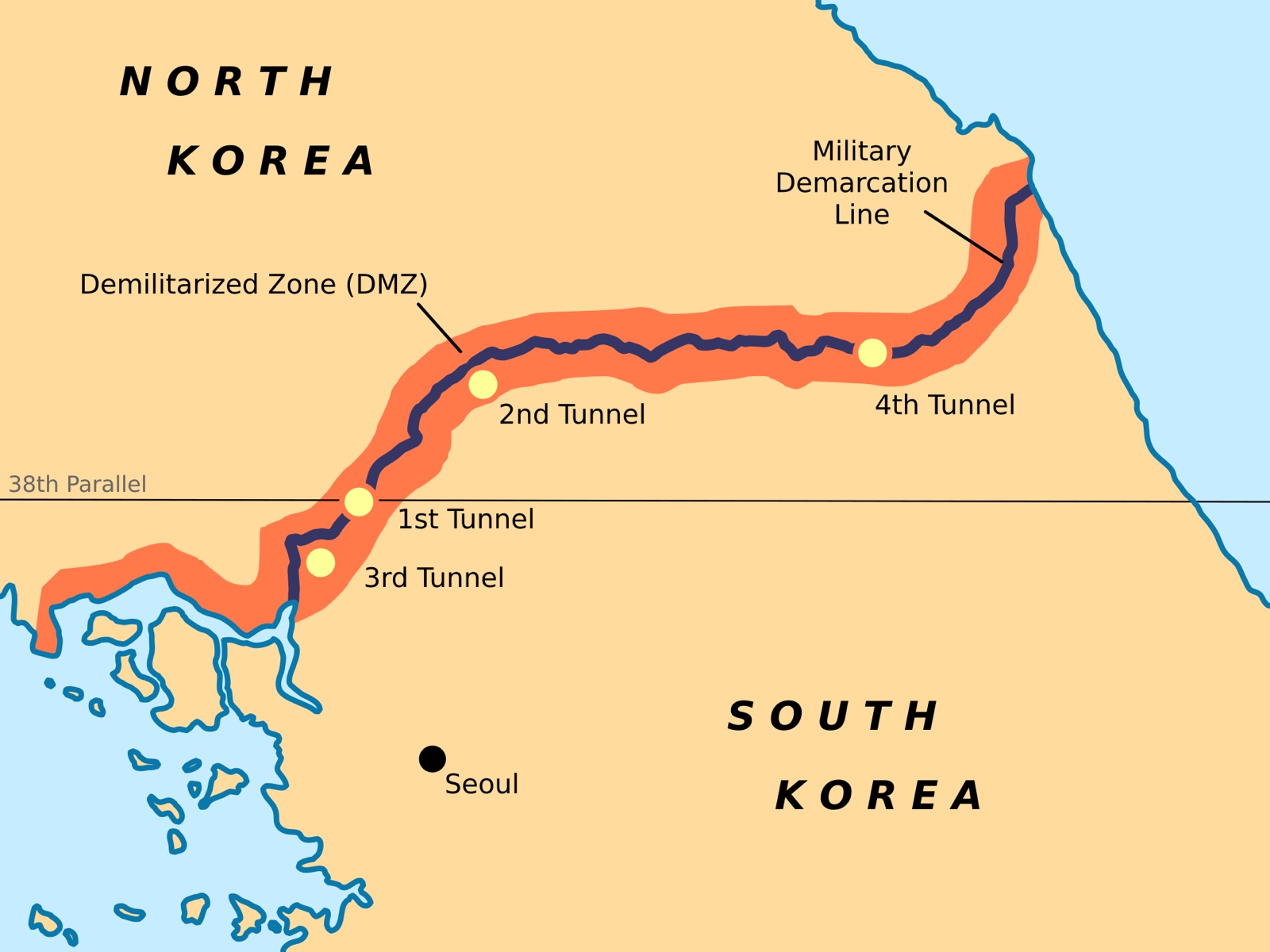
The 1945 dividing line was the straight 38th parallel. The 1953 armistice line follows the front where the fighting stopped: south of the parallel in the west, north of it in the east. The DMZ is the band around it. Map: Rishabh Tatiraju / Wikimedia Commons, CC BY-SA 3.0
The US State Department says the two powers agreed to divide Korea temporarily, to oversee the removal of Japanese forces. Rusk's account describes an American staff decision. No Korean appears in it.
When exactly?
Rusk's 1950 memo places the meeting on the night of 10–11 August 1945. National Geographic quotes his later memoir as dating it to 14 August. We follow the earlier, contemporary memo.
Temporary became permanent when Moscow and Washington couldn't agree. In 1948 each half built its own state.
A US–Soviet Joint Commission was meant to prepare a single Korean government. It met in 1946 and again in 1947, and deadlocked.
In September 1947 the United States took the question to the United Nations. The UN called for elections, and the North boycotted them.
The Republic of Korea was founded in the South in August 1948, under . The Democratic People's Republic of Korea followed in the North in September, under .
Each claimed the whole peninsula. South Korea's constitution still says its territory “shall consist of the Korean peninsula and its adjacent islands”. North Korea long claimed Seoul as its capital, and only formally named Pyongyang in 1972.
Timeline
From one colony to two states
Colony
Japan annexes KoreaColonial rule lasts 35 years.
Division
The 38th parallel is proposedTwo US officers, overnight; the Soviets accept.
LiberationJapan surrenders.
US–Soviet Joint Commission deadlocks
Korea goes to the UNUN calls for elections; the North boycotts.
Republic of Korea foundedSyngman Rhee, Seoul.
DPRK foundedKim Il Sung, Pyongyang.
War
North invades
China enters the war
Armistice signed at PanmunjomSouth Korea does not sign.
Why the fighting of 1950–53 ended in a ceasefire, not a peace, and why that still matters.
In June 1950 the North tried to unify Korea by force, and the world piled in.
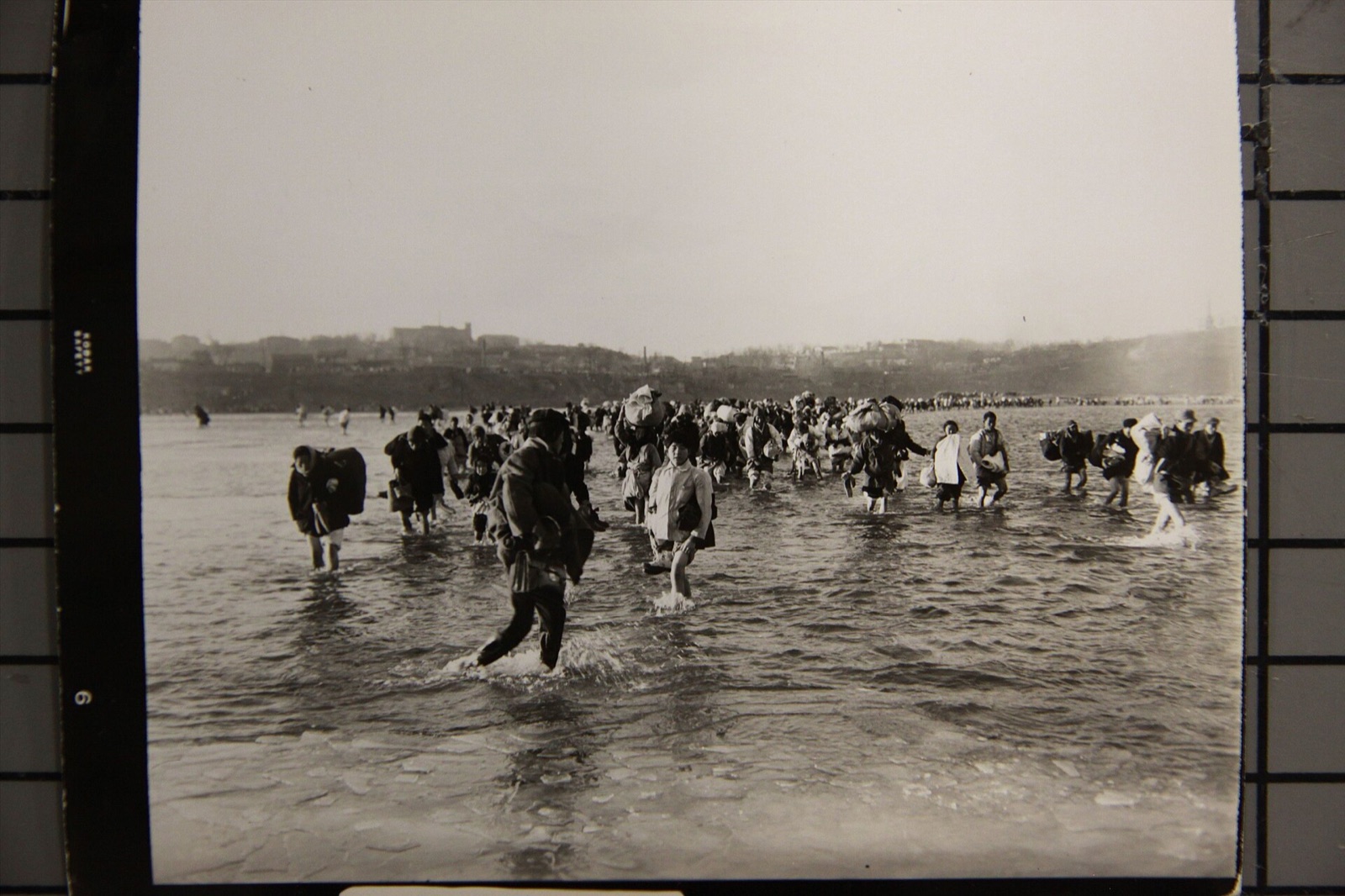
On 25 June 1950 North Korean forces attacked across the 38th parallel.
The UN Security Council called on the North to withdraw the same day. Two days later it recommended that members help South Korea “repel the armed attack”. The Soviet Union, which could have vetoed both, was absent.
On 7 July the Council put those forces under “a unified command under the United States of America”. That body, the , still exists, and still oversees the truce on the southern side.
As UN forces pushed north, Chinese troops crossed the Yalu River on 19 October 1950 and entered the war on the North's side.
✓Answered: Why did the Korean War never formally end, and does that still matter?
Three years of war killed millions of people. Nobody knows exactly how many.
The US National Archives counts 36,576 American dead. National Geographic puts South Korean military deaths at about 46,000, and says as many as four million civilians are thought to have died.
Other summaries give around one million military deaths on all sides, and between 1.5 and 3 million civilian deaths. Treat every total as an estimate.
By the numbers
The cost of the war — estimates
36,576US dead (US National Archives)
~46,000South Korean military dead (estimate)
~1 millionMilitary dead, all sides (estimate)
1.5–4 millionCivilian dead (range of estimates)
All civilian totals are estimates; sources differ widely.
The 1953 armistice stopped the shooting. It was never meant to be the peace.
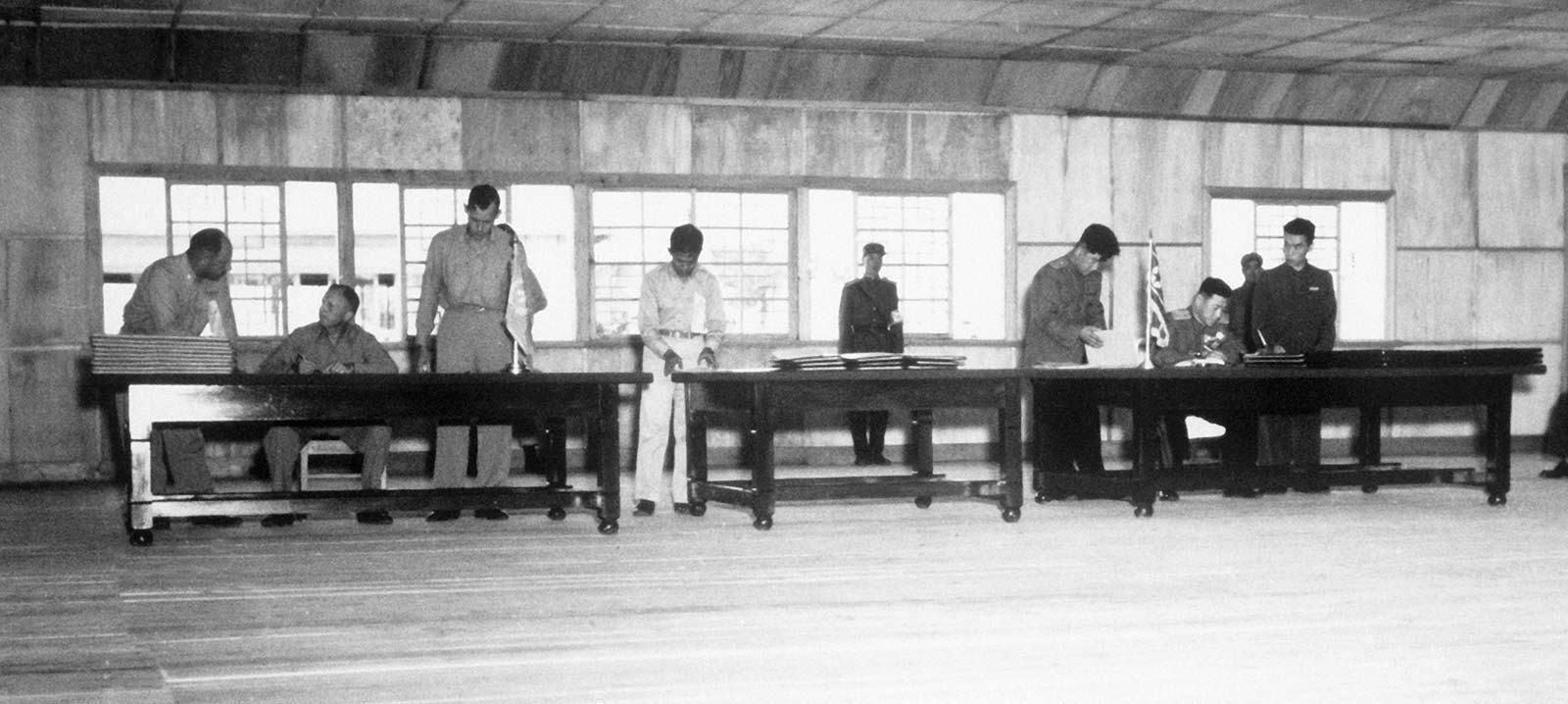
The was signed at on 27 July 1953, after 158 meetings spread over two years.
It was concluded in the names of three commanders: Kim Il Sung for the North Korean army, Peng Dehuai for the Chinese volunteers, and the American general Mark Clark for the UN Command. At Panmunjom itself, the senior delegates, General Nam Il and Lieutenant General William K. Harrison Jr., signed it. The US National Archives calls it “purely a military document”.
It fixed a demarcation line and pulled both armies back two kilometres from it, creating a buffer four kilometres wide. Sources put the line's length at between about 238 and 250 kilometres.
It was explicitly temporary. It stays in force until replaced by “an appropriate agreement for a peaceful settlement at a political level”, and it recommended a political conference within three months.
Side by side
What the 1953 armistice is, and what it isn't
The armistice (1953)
A peace settlement (never reached)
Signed by
Military commanders: UN Command, North Korean army, Chinese volunteers. South Korea did not sign.
Governments.
What it settles
A ceasefire line, a 4 km buffer zone, prisoner exchanges.
Recognition, borders, withdrawal of foreign forces.
How long
Until 'expressly superseded' by a political settlement.
Permanent.
Status
Still in force, 73 years on.
Recommended within three months in 1953; Geneva 1954 failed; 2018 pledge unfulfilled.
South Korea refused to sign, and the promised peace never came.
Syngman Rhee opposed a truce that left Korea divided. On 18 June 1953, about 25,000 North Korean prisoners who did not want to go home walked out of UN camps. The UN Command said the release was planned “at top levels in the Korean Government”.
South Korea never signed the armistice. The political conference met in Geneva from April to June 1954, and its Korean talks ended without any agreement.
In April 2018 the two Korean leaders pledged “to declare the end of war this year” and to work towards a peace agreement with the United States and China. It did not happen. That is why the two Koreas are, technically, still at war.
04Two countries, one peninsula
How far apart the two Koreas now are, and why every number about the North is an estimate.
One is a rich democracy of about 52 million. The other is a one-party state of about 27 million, with nuclear weapons.
Side by side
Two Koreas side by side
South Korea (Republic of Korea)
North Korea (DPRK)
Capital
Seoul
Pyongyang
People
~51.8 million (2025 census, incl. foreigners)
~26.6 million (UN estimate, 2025)
System
Presidential democracy; one five-year term
One-party state led by the Workers' Party
Leader
Lee Jae Myung, since 4 June 2025
Kim Jong Un
Economy
~$2.25 trillion in 2026 (IMF forecast)
~$33.8 billion national income in 2025 (Bank of Korea estimate)
Nuclear weapons
None
~60 assembled warheads (SIPRI, Jan 2026); estimates vary
Main allies
United States (1953 treaty, ~28,500 troops)
Russia (2024 treaty); China (1961 treaty)
Every North Korean figure is an outside estimate.
South Korea's population is about 51.8 million, counting foreign residents. The UN estimates North Korea's at about 26.6 million.
South Korea is a presidential democracy. In 2025 its Constitutional Court removed a sitting president. North Korea is a one-party state led by , general secretary of the .
Who rules in Pyongyang
Kim Jong Un's sister, Kim Yo Jong, was promoted to full department director at the party congress in February 2026. South Korea's spy agency describes his daughter, , as his likely heir. Analysts at KEI note the congress did not formally confirm it and call that judgement premature.
✓Answered: How far apart are the two economies, and how can anyone measure the North's?
By the best outside estimate, the South's economy is about 56 times bigger.
North Korea has not published regular national accounts since the 1960s. The standard estimate comes from South Korea's central bank, the .
Its latest, released on 31 July 2026, put North Korea's 2025 at 48.5 trillion won, about $33.8 billion. That is about one fifty-sixth of South Korea's.
Per person, the North's income is about one twenty-eighth of the South's. In dollars, the IMF expects South Korea's economy to reach about $2.25 trillion in 2026, or $43,512 per person.
Chart
Income per person, 2025
South Korea52.57million won
North Korea (estimate)About 1/28 of the South1.873million won
Bank of Korea figures, in millions of won. North Korea's is an estimate.
The North has grown for three straight years, and Russia is a big reason.
The Bank of Korea estimates growth of 3.1% in 2023, 3.7% in 2024 and 3.5% in 2025. A bank official said real output has now passed its 2017 level, when UN sanctions were imposed.
“The expansion of economic cooperation with Russia was a major driver of North Korea's growth last year,” a bank official said. Manufacturing grew 6.6%, and construction 6.3%. Trade rose 16% to $3.13 billion.
Chart
North Korea's growth, by the Bank of Korea's estimate
20233.1% real GDP growth
20243.7% real GDP growth
20253.5% real GDP growth
Night-time light, a rough satellite measure of activity, tells a more cautious story. An analysis reported by IBTimes found it rose sharply in 2022–23, then was flat from 2023 to 2025.
✓Answered: Who backs whom, and has Russia's war changed the balance?
Nobody really knows the North's numbers. Critics say the estimate is too high, and too low.
The Bank of Korea values North Korean output using South Korean prices and value-added ratios. An economist at the Korea Economic Institute of America says the results “should be viewed with a grain of salt”.
DisputedIs the Bank of Korea's estimate right?North Korea publishes no national accounts. How good is the outside estimate?
Bank of Korea
Estimates output with South Korean prices and value-added ratios, from data supplied by South Korean agencies.
Critics: too high
38 North argues the method assumes no forced extraction of labour and inflates value added; it cites an estimate of a 25% fall in 2017–22 where the bank found 8.4%.
Critics: too low
Analysts at the Peterson Institute have argued the estimate is 'downwardly biased' because it misses quality gains and unofficial activity.
Where it stands: Unresolvable with public data. Treat the gap as an order of magnitude, not a precise ratio.
Critics at 38 North argue the method inflates output; they cite a professor's estimate that the economy shrank by 25% in 2017–22, where the bank found 8.4%. Others argue the opposite: that it misses private, off-the-books activity. The safest reading is an order of magnitude: the South is dozens of times richer.
05The bomb nobody can count
How many nuclear weapons North Korea has, who estimates what, and why the numbers differ.
North Korea has tested six times, and has made its bomb non-negotiable by law.
North Korea carried out six nuclear tests between October 2006 and September 2017. The last was the largest; independent estimates put it at 120 to 160 kilotons.
In September 2022 it passed a law allowing pre-emptive nuclear strikes. Kim said it drew “an irretrievable line so that there can be no bargaining over our nuclear weapons”. A year later the policy was written into the constitution.
It has also tested solid-fuel . The Hwasong-19 flew for about 86 minutes in October 2024. A newer Hwasong-20 was paraded in October 2025 but had not been flight-tested by October 2026.
Timeline
Building the bomb
9 Oct 2006 – Sep 2022
First nuclear test
Tests two to fiveMay 2009, 2013, January and September 2016.
Sixth and largest testIndependent estimates 120–160 kilotons.
Kim tours nuclear-material plantsCalls nuclear status an 'irreversible reality'.
✓Answered: How many nuclear weapons does North Korea have, and why do estimates differ so much?
Estimates run from about 57 to 130 weapons, depending on who is counting and what.
The Stockholm institute estimates that North Korea had possibly assembled around 60 warheads by January 2026, up from 50 a year earlier. It says the North has enough fissile material for at least 30 more.
Trump has put the number at 57. On 20 August 2026 South Korea's then defence minister, Ahn Gyu-back, told parliament: “We generally estimate the number at between 80 and 120.” He later said the figure came from a research institute, not the military.
A researcher at South Korea's defence institute, KIDA, estimated capacity for about 130 weapons. He called that a theoretical maximum, assuming all the material is used without loss.
Chart
How many nuclear weapons? It depends who you ask
TrumpStated figure57weapons (estimates)
SIPRI: assembledJanuary 202660weapons (estimates)
SIPRI: material forAssembled plus 'at least 30 more'90weapons (estimates)
Cited by defence minister: lowDomestic research institute's range, not an official assessment80weapons (estimates)
Cited by defence minister: high120weapons (estimates)
Assembled warheads and weapons-worth of material are different measures.
The estimates differ because uranium is easy to hide, and no inspector has been inside since 2009.
Low numbers count warheads thought to be assembled. High numbers count how many could be made from the material the North is believed to have.
North Korea makes two bomb fuels. comes from a reactor at Yongbyon that satellites can watch. is made in centrifuge halls that can be hidden, and nobody knows how many there are.
In September 2025, Chung Dong-young said the North might have up to 2,000 kilograms of highly enriched uranium, with centrifuges running at four locations. He first presented it as an intelligence assessment; his ministry later attributed the figure to civilian experts.
The , the UN's nuclear watchdog, has had no inspectors in North Korea since 2009.
Side by side
Why the estimates differ
Low end (~50–60)
High end (80–130)
What is counted
Warheads thought to be assembled
Weapons the fissile material could make
Who says so
SIPRI (~60); Trump (57)
A research institute cited by Seoul's then defence minister (80–120); a KIDA researcher (~130)
In their own words
SIPRI: 'possibly assembled'
KIDA: a 'theoretical maximum' assuming no losses
The big unknown
How much highly enriched uranium exists, and at how many hidden sites
Same; assumptions per bomb range from about 10–12 kg to 25 kg of uranium
Whatever the number, everyone agrees it is growing.
In June 2026 President said the North was producing enough nuclear material for 10 to 20 weapons a year.
In November the IAEA's director, , told its board that a further extension to the Yongbyon enrichment plant had been under construction since mid-September, and was externally complete by late October. He called the expansion “extremely worrying”.
On 25 November Kim toured two nuclear-material plants and called for more warheads. According to CNN's reading of state media, he said attempts to deny his country's nuclear status would be “an open declaration of war”.
06Who stands behind whom
The alliances behind each Korea, and how Russia's war in Ukraine changed the North's position.
South Korea's shield is a 1953 treaty and about 28,500 American troops.
The US and South Korea signed a Mutual Defense Treaty on 1 October 1953. Each promised to “act to meet the common danger” according to its constitutional processes, and the US gained the right to base forces in and around South Korea.
About 28,500 US troops are stationed there.
In a war, South Korea's forces would fight under a combined command led by an American general. Seoul handed control to the US commander in July 1950, and took back peacetime control in 1994. It still does not hold .
Lee wants it back before his term ends in 2030. The US commander, General , says the transfer must stay “firmly conditions-based”. In April he told Congress the roadmap aimed at early 2029.
Russia's war turned North Korea from an isolated state into a paid ally.
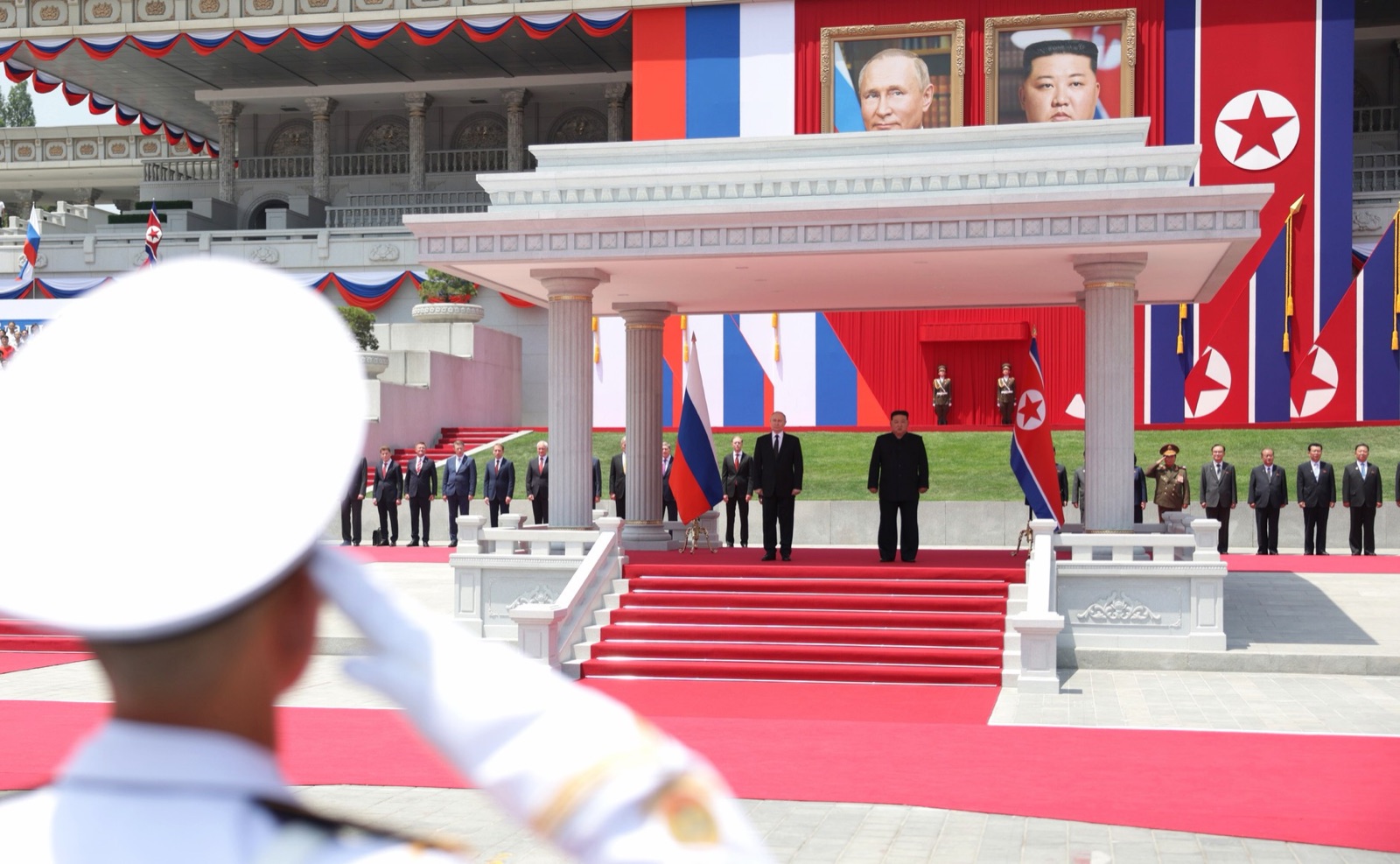
During 's visit to Pyongyang in June 2024, the two countries signed a treaty with a mutual-defence clause. If either is “put in a state of war by an armed invasion”, the other must give military and other assistance without delay. It came into force on 4 December 2024.
North Korea sent troops to help Russia drive Ukraine's forces out of Kursk, and admitted it in April 2025. In February 2026 South Korea's spy agency, the , said about 11,000 were stationed in Kursk, and that about 6,000 had been killed or wounded.
The North also sent artillery shells and ballistic missiles. Estimates of what it earned vary widely. One, reported by Ukrinform, puts it at $7.7 billion to $14.4 billion between August 2023 and December 2025.
By the numbers
What Russia's war has meant for the North
~11,000North Korean troops in Kursk, early 2026 (NIS)
~6,000Killed or wounded (NIS)
$7.7–14.4bnEstimated earnings, Aug 2023–Dec 2025
Seoul's and others' estimates; North Korea publishes none.
A crack in the alliance?
On 26 November 2026, Ukraine's military intelligence claimed North Korea had paused deliveries of missiles and shells to Russia, after Moscow offered to help ease tensions with Seoul. The Kyiv Independent said it could not verify the claim, and neither can we.
Note that Seoul's figure of about 6,000 counts the killed and the wounded together; it is not a death toll.
The war has also strained Seoul's ties with Kyiv. On 23 September 2026 Volodymyr Zelensky told the UN General Assembly that Ukraine had transferred two captured North Korean soldiers to South Korea. Seoul said that broke an agreement to keep the transfer confidential; Kyiv denies there was one. South Korea decided on 8 October to recall its ambassador, and on 20 October said it would pull more staff from its embassy, keeping a chargé d'affaires in Kyiv. We found no later development.
China is the North's oldest ally and almost its only trading partner.
China and North Korea have had a treaty of mutual aid since 1961. It stays in force unless both agree to change or end it.
China accounted for 98.2% of North Korea's trade in 2025. visited Pyongyang on 8 and 9 June 2026, his first trip there in seven years, and said relations had entered “a new historical stage”.
In October a new bridge over the Yalu River opened between the Chinese city of Dandong and North Korea's Sinuiju. China's premier said ties were “opening a new chapter”. Kim then made a same-day visit to Dandong, according to reports.
Side by side
Who stands behind whom
United States → South
Russia → North
China → North
Treaty
Mutual Defense Treaty, 1953
Comprehensive Strategic Partnership, 2024
Mutual aid treaty, 1961
Military tie
~28,500 US troops; US-led wartime command
North Korean troops and shells for Russia's war
Treaty promise of aid
Money and trade
—
Payments for arms and troops (estimates $7.7–14.4bn)
98.2% of North Korea's 2025 trade
2026
Drills cut in August; alliance meeting delayed to 2027
Treaty 'obligations' reaffirmed in May
Xi visits Pyongyang in June; new bridge opens in October
With Moscow and Beijing both close, Kim has less need for Seoul, or even Washington.
Analysts at the Korea Economic Institute of America credit arms sales to Russia and trade with China for the North's recovery. Sanctions bite less when both big neighbours are open for business.
In November Trump said a meeting with Kim in China was “up to President Xi”. On 19 November Trump, Xi and Putin held their first three-way meeting, in Shenzhen.
How Pyongyang abandoned reunification, how Seoul changed course, and why South Koreans have cooled on unification too.
For decades both Koreas said they were one nation, temporarily divided.
In 1991 the two Koreas joined the UN as separate members on the same day, 17 September. Three months later they signed a Basic Agreement. It described their ties as “not being a relationship between states” but “a special interim relationship” on the way to reunification.
In April 2018 their leaders met at Panmunjom and pledged “complete denuclearization” and an end to the war. A military agreement that September created no-fly zones near the border and pulled back guard posts.
✓Answered: Why did North Korea give up on reunification, and do South Koreans still want it?
Then Kim declared the South a separate, hostile state, and ordered the word ‘reunification’ erased.
At a party meeting in December 2023, Kim said relations had become those between “two states hostile to each other”. On 15 January 2024 he told the Supreme People's Assembly: “we cannot go along the road of national restoration and reunification together.”
He called for the South to be defined as the “primary foe and invariable principal enemy”. He ordered concepts like “reunification” and “fellow countrymen” eliminated, and the agencies for reunification were abolished.
We cannot go along the road of national restoration and reunification together.Kim Jong Un, 15 January 2024
On 15 October 2024 the North blew up sections of the road and rail links across the border. Its constitution was revised in March 2026, the change disclosed in May, and the full text published in November. It drops every reference to reunification and names “the Republic of Korea” as its southern neighbour, without calling it hostile.
Timeline
From 'one nation' to 'two hostile states'
One nation, two states
Both Koreas join the UN
Basic Agreement'Not a relationship between states.'
Panmunjom DeclarationPledge to end the war 'this year'.
The break
'Two states hostile to each other'
South named 'primary foe'Reunification agencies abolished.
Seoul suspends the 2018 military deal
North blows up sections of border roads and rail
Ninth Party Congress reaffirms the line
New constitution publishedNo reunification; names 'the Republic of Korea' to the south.
Readings
Why did Kim drop reunification? Outside readings
1Argued
Shutting out the South's influence
The caseChristopher Green, of Leiden University and the International Crisis Group, argues the regime had long feared South Korean films, music and ideas reaching its people, used the pandemic border closure to shut them out, and that rejecting the South altogether was the end point of that thinking.
The counterPyongyang's own account cites Seoul's hostility, not culture. And this would not by itself explain why the break came when it did.
2Argued
A world that made the break cheap
The caseGreen also points to outside shifts: US–China rivalry drew China closer, and the partnership with Russia brought arms deals and cover from Western pressure. Yoon's hard line, with Washington's 'strategic patience', led Pyongyang to conclude it had nothing to lose.
The counterGreen himself says strategy alone is not enough: Kim could have confronted Seoul without scrapping unification, as Seoul strengthened its defences without dropping its own.
3Reported
A bargaining stance for Washington
The caseDaily NK, citing an unnamed source, reported that the doctrine is meant to win recognition as a 'normal country' in later negotiations with the United States.
The counterThe source cannot be checked, and in November 2026 Kim Yo Jong said there was 'no need' to sit down with hostile people.
Does the constitution call the South 'hostile'?
No. An NCNK briefing says it formally describes South Korea as a hostile state, but reports that read the published text contradict that: Korea Times and JoongAng find no “primary foe”, “invariable principal enemy” or hostile-state label. What all agree on is that reunification is gone.
Seoul went the other way: a liberal president who wants ‘peaceful coexistence’.
In South Korea, President declared martial law on 3 December 2024. He was impeached, and the Constitutional Court removed him on 4 April 2025.
Lee Jae Myung had lost the 2022 election by 0.73 points. He won the snap election on 3 June 2025 with 49.4% of the vote.
Lee suspended loudspeaker broadcasts at the border and curbed leaflet launches. He set out a three-step path, freeze, then reduce, then denuclearise, accepting a freeze as an interim measure.
At a time when we'd be fortunate just to avoid war, let alone achieve unification…
— Lee Jae Myung, 21 January 2026
✓Answered: What is Seoul trying to do, and why is it divided?
South Koreans have cooled on unification too, but they don't trust the North.
In an April 2026 survey by KINU, a state think tank, 66.9% agreed unification is unnecessary if the two Koreas can coexist peacefully. 71.6% saw the North as a separate state.
A Seoul National University survey in July, carried out by Gallup Korea, found 78.3% think “dialogue and compromise” with the North impossible. 61.1% supported South Korea having its own nuclear weapons, up from 51.8%. Only 39% said unification was necessary.
By the numbers
What South Koreans think, 2026
66.9%Unification unnecessary if peaceful coexistence is possible (KINU, Apr)
78.3%Dialogue and compromise with the North impossible (SNU, Jul)
61.1%Support South Korean nuclear weapons (SNU, Jul)
39%Say unification is necessary (SNU, Jul)
Two different surveys: KINU (April) and Seoul National University (July).
✓Answered: Is war, or reunification, actually realistic — and what should we watch?
08How 2026 went cold
What changed this year: the drills, the mine, the missiles, and a summit that didn't happen.
In August Trump cut the allies' main drill, partly, he said, because Seoul wouldn't join him on Iran.
On 16 August 2026 Trump ordered the US to “substantially reduce” its part in the annual exercise, calling it “costly”. The drills were cut from 11 days to five.
He linked the decision to Lee's refusal to join US operations against Iran. “I said, ‘Well, why are we involved in helping you?’” he said. South Korea's foreign minister, , said neither side knew of the order in advance.
Then came the mine, a run of missile launches and new guns on the border.
On 3 October the North fired an intermediate-range missile. Seoul said it flew more than 700 kilometres; Japan said about 680. More launches followed on 12, 14 and 29 October. The last was a salvo of about ten short-range missiles.
South Korea tested its own on 8 October, and Lee called it “successful”. Around 21 October Kim Yo Jong said “new firepower units have taken their firing positions” near the border.
Out of public view, from 29 September to 2 October, the allies had held a tabletop exercise called Iron Mace, on combining South Korea's conventional forces with American nuclear forces. It was disclosed on 29 October. On 2 November a senior North Korean party official said American threats were “escalating with each passing day”.
The line crossings went on. North Korean troops crossed it about 30 times in October and about 10 times in November, according to military figures released on 27 November by an opposition lawmaker. They are monthly totals, without dates for each crossing.
At the end of October, hackers stole about $6.3 billion from the crypto exchange Binance. The FBI blamed North Korea; Kim Yo Jong denied it.
Timeline
How 2026 went cold
Feb 2026 – 21 Sep
Ninth Party CongressHostile-states line confirmed; Kim Yo Jong promoted.
Xi Jinping in Pyongyang
Trump orders drills scaled backUlchi Freedom Shield cut from 11 days to 5.
Mine blast in the DMZThree South Korean soldiers wounded.
29 Sep–2 Oct – 8 Oct
Allies' closed-door Iron Mace exerciseCombining conventional and nuclear forces; disclosed 29 Oct.
Intermediate-range missile
North rejects border talks'Not … under any circumstances.'
South tests its own hypersonic glider
12–29 Oct – 10–11 Nov
More launchesBallistic and cruise missiles; ~10 short-range missiles on 29 Oct.
Alliance meeting pushed to early 2027
About 40 more line crossingsAbout 30 in October, about 10 in November.
North publishes new constitution
19 Nov – 25 Nov
Trump leaves China without meeting Kim
Kim tours nuclear-material plants
Seoul is not of one mind about how to answer, and the alliance's calendar is slipping.
The engagement camp, led by Chung, proposed talks on the line and rejected restarting loudspeakers. At a National Security Council meeting on 1 October, Foreign Minister proposed new unilateral sanctions on the North's cyber operations, and Chung opposed them, according to Korean press reports. By 9 November the idea was still under review.
The defence ministry called its warning shots “legitimate preventive measures” and vowed to “firmly retaliate” against provocations. Defence Minister said “all responsibility” for the blast lies with the North.
DisputedHow should Seoul answer the North?After the mine blast: talk or push back?
Engagement: Lee, Chung Dong-young
Propose talks on where the line runs; don't restart loudspeakers; urge Washington to talk to Pyongyang; aim for a 'peaceful two-state relationship oriented toward unification'.
Deterrence: foreign ministry (reported), conservatives, military
Hold the North responsible; consider sanctions; warning shots are 'legitimate preventive measures' and provocations will meet firm retaliation.
Where it stands: Lee has kept de-escalation measures in place while his military answers line crossings with warning shots.
On 28 October the US and South Korean defence ministers agreed to push their annual to early 2027. No target year was set for handing over wartime command; a US official said it would happen “when the agreed conditions have been met”.
Washington hoped for a Trump–Kim meeting in China. It didn't happen.
Before flying to the APEC summit in Shenzhen, Trump said: “we may meet with Kim Jong-un also… In China… He may come, I don't know. That's up to President Xi.”
Kim had set his price in 2025: talks only if the US drops its “absurd obsession with denuclearising us”. On 4 November Kim Yo Jong said there was “no need to sit down face-to-face with untrustworthy and hostile people”.
On 3 November Democrats won both houses of the US Congress in the midterm elections. Analysts in Seoul disagreed about whether that made a Trump–Kim meeting less likely, or more.
Lee met Xi on 18 November and asked China “to play a constructive role”. Trump left China on 19 November without meeting Kim. Six days later Kim toured his nuclear plants.
What Trump and Xi said about Korea is still unclear. The three leaders' joint declaration does not mention it, and neither does China's readout of Xi's talks with Trump. China's Xinhua news agency said the three “exchanged views on the Korean Peninsula”. Back in Washington, Trump said they had discussed “confronting dangers on the Korean Peninsula”, and gave no details.
09War, peace or drift
Whether war or reunification is realistic, the paths ahead, and the dates to watch.
Four paths are plausible. Reunification is not a near one.
Reunification has no backer in Pyongyang, which has removed it from its constitution. In the South, fewer than half now call it necessary.
War is no one's stated aim. But the border is crowded with new mines, guns and line crossings, and the two sides disagree about where it runs. Chung's own warning was that “a similar accident could happen at any time”.
Readings
Where this could go
1Argued
A Trump–Kim deal
The caseTrump keeps saying he wants to meet; Kim says he could talk if the US drops denuclearisation; Seoul urges talks.
The counterTrump left China without a meeting; Kim Yo Jong says there is 'no need' to meet hostile people; Kim is expanding his arsenal, not trading it.
2Argued
A border clash
The caseMines, new guns and dozens of line crossings; neither side accepts the other's line; Seoul fires warning shots; the North threatens to respond to '1 millimeter'.
The counterBoth sides have so far kept responses limited, and Lee has avoided escalation.
3Our reading
Drift
The caseNo talks with Seoul, missile tests, fortification, and backing from Moscow and Beijing that reduces the North's need for anyone else.
The counterDrift can be broken by a single summit or a single incident.
4Our reading
Reunification
The caseSouth Korea's constitution still claims the whole peninsula and commits to peaceful unification.
The counterThe North has removed reunification from its constitution; fewer than half of South Koreans call it necessary.
Our reading: the Korean problem is being redefined, from a divided nation to two states.
For most of 70 years both sides said they were one nation waiting to be reunited. Now Pyongyang says two hostile states. Seoul's unification minister talks of “a peaceful two-state relationship oriented toward unification”.
The standoff isn't over. These are the things that will move it.
Timeline
What to watch
Kang–Hegseth meeting in Washington
58th Security Consultative MeetingWill a target year for wartime command be set?
The border lineCrossings, warning shots, new firepower units.
Trump–Kim contactLetters or a meeting, and on what terms.
Russia tiesIs the reported pause in arms deliveries real?
Yongbyon and new warheadsIAEA reports; any nuclear test.
What we still don't know: how many weapons the North really has, where exactly each side thinks the line runs, what, if anything, Trump and Xi agreed about Korea, and whether the North really has paused its arms deliveries to Russia.
What do you think we missed? Ask, and we'll answer it in the next version.
You made it
What you now know
The 10 questions this story set out to answer, in one line each.
Why are there two Koreas at all, when neither side ever accepted the split?
In August 1945 two American officers proposed the 38th parallel as a temporary line for taking Japan's surrender, the Soviets accepted, and when US–Soviet talks on a single government deadlocked, each zone founded its own state in 1948, each claiming the whole peninsula.
Why did the Korean War never formally end, and does that still matter?
The 1953 armistice was a military ceasefire signed by commanders, not governments; South Korea refused to sign, the 1954 Geneva conference produced no settlement, and the 2018 pledge to declare an end to the war was never carried out, so the line itself still has no political agreement behind it.
How far apart are the two economies, and how can anyone measure the North's?
By the Bank of Korea's estimate the South's national income is about 56 times the North's, and about 28 times per person; North Korea publishes no national accounts, so this is a model built on South Korean prices that critics say could be too high or too low.
How many nuclear weapons does North Korea have, and why do estimates differ so much?
SIPRI estimates about 60 assembled warheads as of January 2026; others range from Trump's 57 to an 80–120 range cited by South Korea's defence minister, later attributed to a domestic research institute, and a theoretical maximum near 130, because they count different things and nobody can see the North's uranium enrichment.
Who backs whom, and has Russia's war changed the balance?
The South has a 1953 defence treaty with the US and about 28,500 US troops; the North has treaties with China (1961) and Russia (2024), and its troops and shells for Russia's war have brought it money, growth and diplomatic cover.
Why did North Korea give up on reunification, and do South Koreans still want it?
Since December 2023 Pyongyang has called the Koreas 'two states hostile to each other' and removed reunification from its constitution; in the South, fewer than half now call unification necessary, though most also distrust the North.
What happened in 2026 to turn a cold standoff into a dangerous one?
Trump cut joint drills in August, a North Korean mine wounded South Korean soldiers inside the DMZ in September, the North refused to discuss where the border runs, fired a run of missiles in October, and after Trump left China without meeting Kim, Kim called for more and smaller nuclear weapons.
What is Seoul trying to do, and why is it divided?
President Lee Jae Myung wants 'peaceful coexistence' and a freeze-first path to denuclearisation, and wartime control of his forces back by 2030; his unification ministry leans to engagement while his defence and foreign ministries and the opposition lean to deterrence.
Trump floated a meeting at APEC in China but left on 19 November without one; Kim's stated price is that the US drop denuclearisation, and his sister says there is 'no need' to sit down with hostile people.
Is war, or reunification, actually realistic — and what should we watch?
Reunification has no near-term path; deliberate war is no one's stated aim, but a border clash is a real risk; the most likely near-term path is drift, punctuated by tests and incidents. Watch the early-2027 alliance meeting, the border, and any Trump–Kim contact.
What this story could not settle, and why. Each item is something not known yet, a claim we couldn't confirm, something nobody publishes, or something we checked and left out.
Claimed, not confirmedNo official figureLeft out
Not known yet 2 things can't be known until they happen. They're in What to watch next, just below; the story updates when they land.
Claimed, not confirmedattributed in the text and marked unconfirmed
Why Pyongyang really dropped reunification
Pyongyang presents the break as a response to Seoul's hostility. The other explanations come from outside: the analyst Christopher Green, and Daily NK citing a single unnamed source. Pyongyang has confirmed none of them, and its real motive can't be known from public sources.
What we could confirm: What it did: Kim's 2023–24 speeches, the abolished reunification agencies, and a constitution that drops every reference to reunification.
The three leaders' joint declaration and China's readout of the Xi–Trump talks don't mention Korea, and we found no US readout of the meeting.
What we could confirm: Xinhua said the three leaders “exchanged views on the Korean Peninsula”, and Trump said they discussed “confronting dangers” there. Neither gave details.
Three figures from our earlier briefing that we couldn't trace
We couldn't trace “about 9,000 troops near Kursk” (South Korea's spy agency's 11,000 is used instead) or “$1.98bn of China trade through August” (only earlier monthly figures turned up), and we couldn't open a Washington Times report that the North had doubled its nuclear weapons.
What we could confirm: Kim's June 2026 claim of “more than doubled” output referred to bomb fuel, not warheads.
Will a target year for wartime operational control be set?
The border line
Crossings, warning shots and new North Korean firepower units: the most likely trigger for a clash.
Trump–Kim contact
Letters or a meeting, and whether the US drops denuclearisation as a precondition.
North Korea–Russia arms deliveries
Ukraine's claim of a pause is unverified; a real rift would change Kim's leverage.
Yongbyon and the arsenal
IAEA reports on enrichment; Kim has called for more warheads and battlefield nuclear weapons.
Was this worth your time?
Tell us, and see what other readers said.
Follow this story
Get an email when this story changes. Nothing else.
How this story was made
Carefully crafted by people and AI. AI agents search widely, read the sources and draft the story; a person chooses the subject, shapes and edits it, and decides when it's ready to publish. Every source is listed below, with what was read in full and what we couldn't settle.
Where the figures come from. Facts are as of 27 November 2026. History rests on primary documents: the Rusk memo, the armistice text, UN resolutions and treaty texts. Economic and nuclear figures come from the Bank of Korea, SIPRI and IAEA statements.
How sources were read. 'Full' means this edition's researchers opened and read the page. 'Excerpt' means only a search excerpt, or the reading in the 8 October primer this edition started from, was available.
Blocked sites. AEI–ISW, 38 North, Stimson, CNN and Britannica refused automated fetching. Where we could, we replaced them with Korean press reports or syndicated copies, and we cite CNN and 38 North only as excerpts.
Estimates and disputes. All North Korean economic, troop and nuclear figures are outside estimates. Where sources disagree on a date or number, we show both or print only what they share.
What we couldn't confirm. Pyongyang's real reasons for dropping reunification; what Trump and Xi said about Korea beyond one-line mentions; dates of individual border crossings, which the military releases only as monthly totals; and Ukraine's claim that arms deliveries to Russia have paused.
v1 · 27 Nov 2026 — First edition: the 8 October 2026 primer rebuilt as a narrated story around ten reader questions, researched from primary sources and updated to 27 November 2026.
addedEvents since 8 October: missile launches, the delayed alliance meeting, APEC in Shenzhen without a Trump–Kim meeting, and Kim's 25 November nuclear-plant tour.
addedSeoul's final findings on the mine (about 10 m south of the line) and Pyongyang's refusal to discuss the line.
correctedThe seed's $26.6bn is real GDP, not the size measure; the Bank of Korea's ratio is about 56 times (28 times per person), not about 70.
revisedSouth Korea's figures updated to the IMF's October 2026 outlook: about $2.25 trillion and $43,512 per person (seed: $1.93tn, ~$37,400).
correctedThe constitution was amended in March 2026 and disclosed in May; the full text was published in November. Reports on the published text find no hostile label, contradicting an NCNK briefing.
revisedThe defence ministers' meeting the seed expected in October was pushed to early 2027, with no target year for wartime command.
correctedThe Chung uranium figure now notes he first cited intelligence before his ministry attributed it to civilian experts; the constitution is described as revised in March, disclosed in May, published in November, naming 'the Republic of Korea' without a hostile label. Also tightened: the 80–120 warhead range is a research institute's figure cited by the defence minister, not an official estimate; ~6,000 Kursk casualties are killed or wounded; Yongbyon extension 'externally complete'; armistice signing by delegates; 'sections' of roads destroyed; line crossings 'so far in 2026'; Rusk's dating 'based on memory'; poll wording and pollster.
removedThe seed's unverifiable items: the 'Washington Times: North Korea doubles nuclear weapons' headline, '~9,000 troops near Kursk' and '$1.98bn China trade through August'.
addedWhat the record shows about Trump and Xi on Korea: the Shenzhen declaration and China's readout don't mention it; Xinhua and Trump say it was discussed, without details. Also the 3 November US midterms.
addedThe allies' closed-door Iron Mace nuclear-conventional exercise and Pyongyang's reaction; about 30 line crossings in October and about 10 in November.
addedOutside explanations for Pyongyang's break with reunification, with the case and counter-case for each.
revisedThe Cho–Chung sanctions dispute is now sourced to Korean press reports (1 October NSC meeting; still under review on 9 November) instead of a blocked think-tank update.
addedGo-deeper note on Seoul's row with Kyiv over two North Korean prisoners of war.