The Hindu canon from the Vedas to Ramana Maharshi, read as fact, fiction and spiritual instruction
Some of these texts read like history, some like vast invented stories, and some were never trying to be either. The tradition has its own way of telling them apart. Its dates and its scholars' dates disagree by thousands of years, and in 2026 that gap still reaches the sea floor, the Supreme Court and UNESCO.
This chapter settles what kinds of claim these texts make, and why the tradition labels them differently from us.
In July 1896, a Tamil schoolboy named Venkataraman Iyer was seized by a sudden fear of death. He was sixteen. He did not run from it. He turned it into a question: what is it that dies?
His answer, as he later told it, was that the body dies but something goes on.
It was that current, force or centre that constituted my Self, that kept me acting and moving.
— Ramana Maharshi, recalling 1896
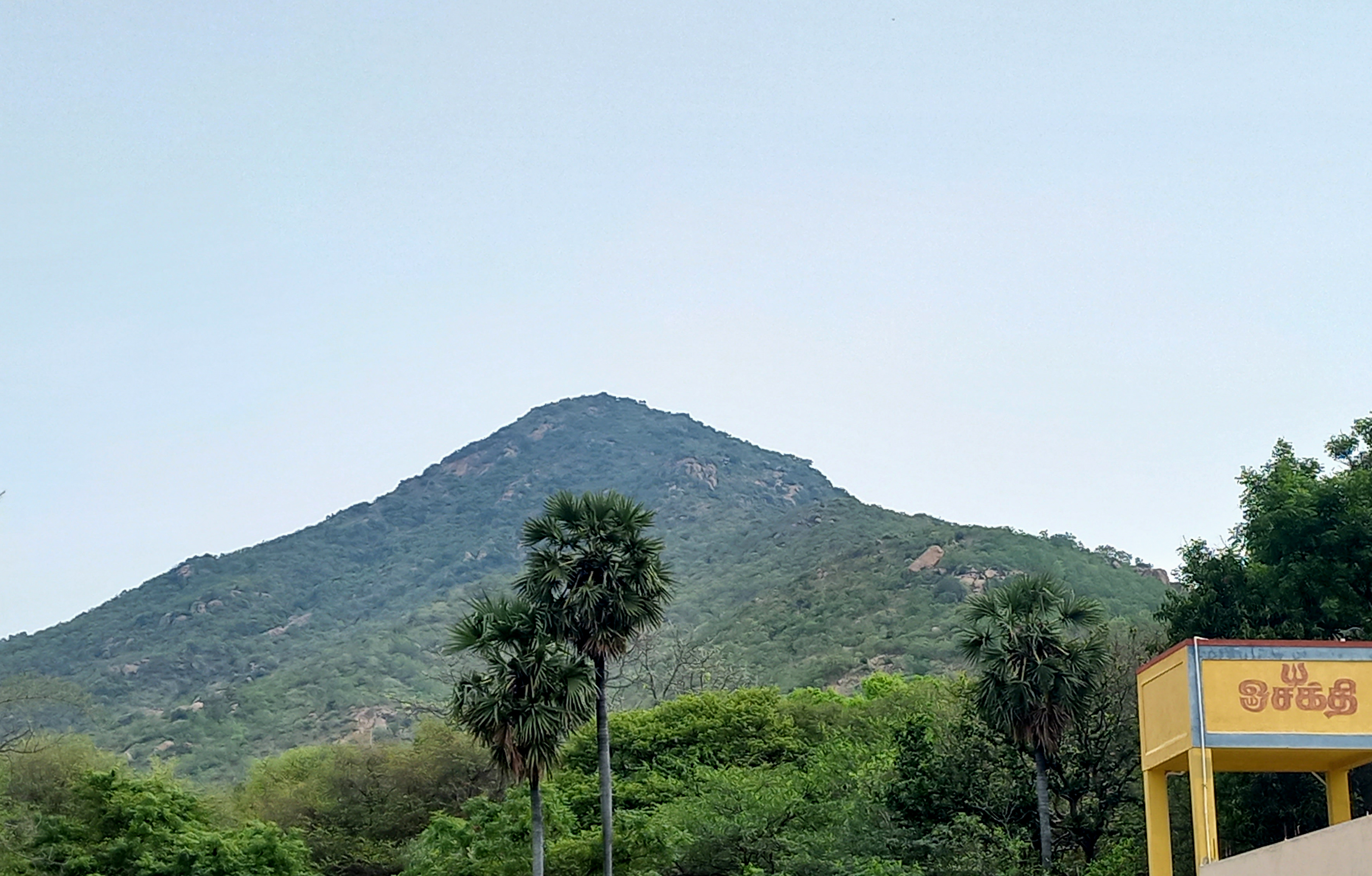
On 1 September 1896 he arrived at Tiruvannamalai, the town below the sacred hill of . He stayed for the rest of his life. The world came to know him as . He died there on 14 April 1950.
He is the last stop on a shelf of texts that runs back more than 3,500 years, to the hymns of the . Keep him in mind. Two ways of dating this tradition will soon disagree by thousands of years. His life is the one line where they agree.
✓Answered: Who was Ramana Maharshi, and why does a 3,500-year story end with a man who died in 1950?
Every text on this shelf can be read three ways: as fact, as story, or as instruction.
Between the oldest hymn and that hill sit the , two vast epics, the Ramayana and the Mahabharata, and the Bhagavad Gita, tucked inside the second. Then come the sprawling and the philosophy of .
The first lens is fact. Did this happen? Could you dig it up or date it? It bites hardest on the epics. Was there a war at , a city at Dwarka, a king called ?
The second lens is story. Is this a made thing, retold and enlarged over centuries? It bites on the Puranas, and on the epics read as literature.
The third lens asks what a text is for. It bites on the Upanishads and Advaita, which aim at a change in who you take yourself to be. Asking whether they are 'true' is a little like asking whether a map is beautiful.
Side by side
Three lenses, three questions
The question it asks
Where it bites hardest
Fact
Did this happen? Could you dig it up or date it?
The epics: a war at Kurukshetra, a city at Dwarka, a king called Rama
Story
Is this a made thing, retold and enlarged over centuries?
The Puranas, and the epics read as literature
Instruction
What is this for? What does it ask you to do or see?
The Upanishads and Advaita: aimed at a change in who you take yourself to be
The original article's framework for reading the canon. A reading aid, not the tradition's own classification.
✓Answered: Are these texts history, fiction or something else, and how does the tradition itself sort them?
But the tradition never filed its books under history and myth.
The tradition sorts its library by how each text came down, not by subject. The Vedas are , 'what is heard'. Hindus hold them to be apauruseya: not made by any person, and without an author. What came after is , 'what is remembered'.
The epics get a third label. They are , from the phrase iti ha asa, 'so indeed it was'. The tradition has long treated them as authoritative accounts of past events. Yet it also calls them, with the Puranas, a . History and scripture share one name.
Side by side
How the tradition labels its own books
What the word means
What it covers
Shruti
'What is heard'; held to be authorless
The four Vedas, all four layers, up to the Upanishads
The Ramayana and the Mahabharata; with the Puranas, a 'fifth Veda'
By how each text came down, not by subject.
So this story walks the shelf from oldest to newest. Of each text it asks the question the tradition cares least about. How much is history you could recover? How much grew in the telling? And how much was never meant to be a fact at all?
02One library, two clocks
This chapter settles how the canon is layered and why its dates disagree by thousands of years.
The library has two storeys: the heard Vedas below, everything remembered above.
Start at the foundation. There are four Vedas: the Rigveda, Yajurveda, Samaveda and Atharvaveda. Each has four layers. The hold the mantras and blessings. The comment on the rituals. The deal with rituals and their symbolic meaning. The turn to meditation, philosophy and the self.
All four layers count as heard. Above them sits the remembered storey: the two epics, the Gita, the Puranas, and the philosophy built on top.
Notice where the line falls. The Upanishads are the top floor of the heard Veda. They are also the foundation of what comes next. The philosophy at the top of the building calls itself , 'the end of the Vedas'. Its three founding texts are the Upanishads, the Gita and the .
How it fits together
One library, two storeys
Vedanta: the philosophy schoolsSmriti · built on Upanishads, Gita and Brahma Sutras
Vishishtadvaita RamanujaDvaita Madhva
PuranasSmriti · first versions c. 3rd–10th century CE
Itihasa: the two epicsSmriti · 'so indeed it was'
RamayanaMahabharata the Gita sits inside
UpanishadsShruti · meditation, philosophy, the self
The hingeTop floor of the heard Veda, foundation of what is remembered
↓ ↑ Vedanta builds on it
AranyakasShruti · rituals and their symbolism
BrahmanasShruti · commentary on the rituals
Samhitas: the hymnsShruti · Rigveda core c. 1500–1200 BCE
RigvedaYajurvedaSamavedaAtharvaveda
Newest on top. The four layers of each Veda count as heard; everything above is remembered.
Two clocks run through this subject, and on the deep past they disagree by millennia.
Every date in this story comes from one of two clocks.
The tradition's clock counts in cosmic ages. Its anchor is the start of the current dark age, the , at midnight on 17–18 February 3102 BCE. That date is worked back from the astronomer , who wrote in 499 CE that 3,600 years of the Kali Yuga had passed. The tradition links that moment to Krishna's death, so the great war falls just before it. One traditional chronology, that of the Vedic Foundation, puts the war at 3138 BCE.
The historian's clock is built from language, archaeology and the first outside references to a text. On it, the Kuru realm where the epic is set was a centre of power from roughly 1200 to 800 BCE, according to the Indologist Michael Witzel. Most of the Mahabharata's text was probably compiled between the 3rd century BCE and the 3rd century CE.
So the same war sits about two thousand years apart on the two clocks. The historian A. L. Basham called a date of 3102 BCE 'quite impossible'.
Side by side
Two clocks for one tradition
The tradition's clock
The historian's clock
The Vedas
Heard and authorless: no human date
Rigveda core c. 1500–1200 BCE
The Upanishads
Part of the heard Veda
Principal ones c. 800–300 BCE
The Mahabharata war
Just before the Kali Yuga, which began 3102 BCE; the Vedic Foundation's chronology says 3138 BCE
Unproven; Kuru realm c. 1200–800 BCE
The Mahabharata text
Composed by Vyasa
Bulk 3rd century BCE–3rd century CE
The Puranas
Eighteen composed by Vyasa
First versions 3rd–10th century CE
Adi Shankara
5th century BCE, per the monasteries
c. 700–750 CE
Ramana Maharshi
1879–1950
1879–1950
Oldest first. Scholarly ranges are those given in the reference works we opened.
✓Answered: Why do the tradition's dates and the historians' dates differ by thousands of years?
The gap is widest at the start, and it closes to nothing in 1950.
Follow the clocks forward and the gap shrinks. To the tradition, the Vedas have no human author, so they have no human date. Scholars place the Rigveda's core around 1500 to 1200 BCE. For the philosopher Shankara, the two clocks are about twelve centuries apart.
Only one entry gets the same date on both. It is , born in 1879 and dead in 1950. He is the boy who asked what dies.
Timeline
The shelf on the historian's clock
Tradition's anchor
Kali Yuga begins, by the tradition's countWorked back from Aryabhata's statement of 499 CE
Vedic age
Rigveda hymns composed
Kuru realm at the centre of powerPainted Grey Ware culture, c. 1200–500 BCE
Principal Upanishads
The epics
Ramayana's first, oral stage, with later stages to the 3rd century CEScholarly estimates range from the 8th–5th to the 5th–4th century BCE
Bulk of the Mahabharata compiledThe Gita generally dated to the 2nd or 1st century BCE
Puranas and philosophy
First versions of the Puranas
Adi Shankara, by current scholarship
Modern
Ramana Maharshi: same dates on both clocks
BORI's critical edition of the Mahabharata
Approximate scholarly dates; tradition's anchors in the other colour. Not to scale.
03Carried by voice
This chapter settles how the oldest texts survived, what they say, and the turn inward that later texts build on.
The Rigveda survived for more than a thousand years by voice alone.
The Rigveda is the oldest of the four Vedas. It holds 1,028 hymns in about 10,600 verses. Scholars most often date its composition to between about 1500 and 1000 BCE, though the dating is still contested.
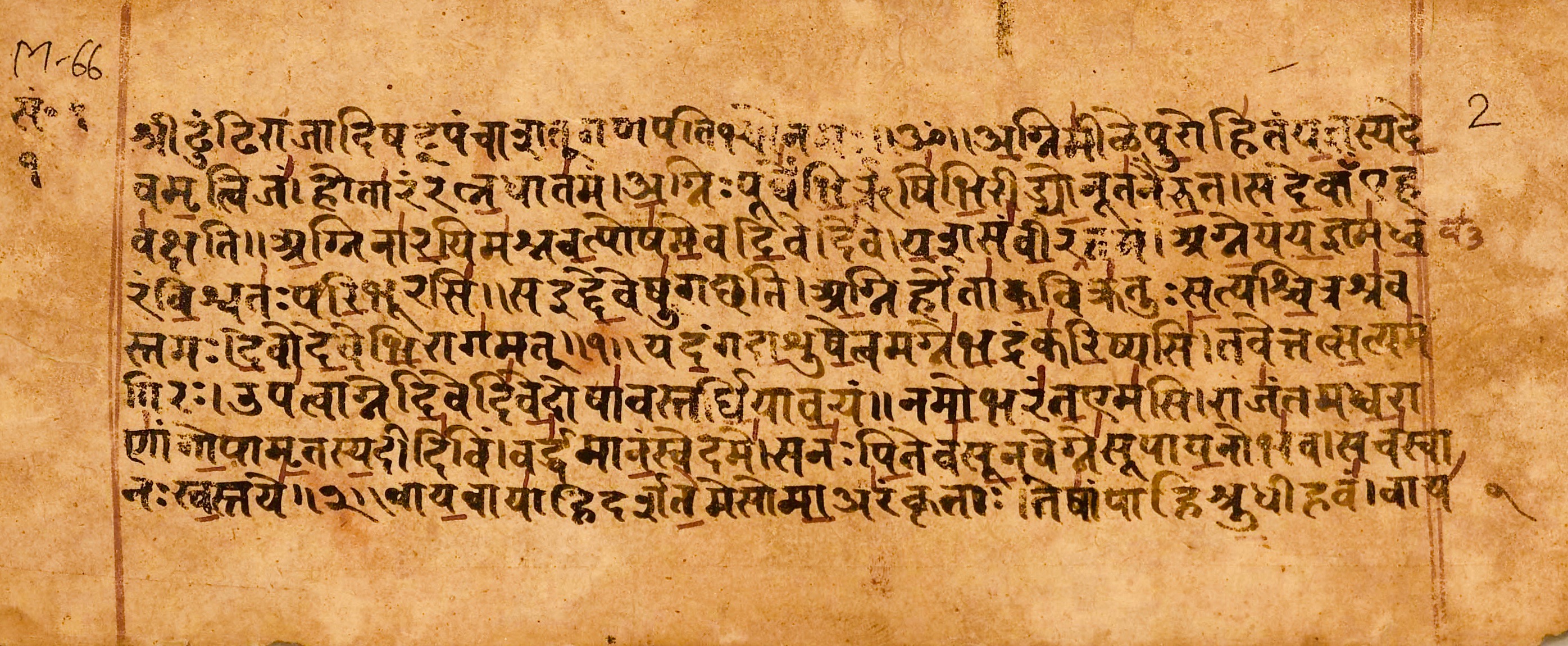
For centuries it was not written down. One reference summary says it was 'preserved with unparalleled fidelity for more than a millennium by oral tradition alone'. Reciters learn from childhood, using techniques built on tonal accents. UNESCO says the aim is 'to ensure that the sound of each word remains unaltered'. One recited form isolates every word. Another joins the words by the rules of sound.
A handwritten Devanagari page with the opening hymn of the Rigveda. Paper copies like this came long after the hymns: the oldest surviving manuscripts date to about 1040 CE. Photo: Ms Sarah Welch / Wikimedia Commons, CC BY-SA 4.0
The oldest surviving manuscripts, from Nepal, date only to about 1040 CE. Thirty Rigveda manuscripts in Pune joined UNESCO's register in 2007. UNESCO also lists Vedic chanting itself as living heritage. It warns that only 13 of more than a thousand recitation branches have survived.
By the numbers
A text carried by voice
1,028hymns in the Rigveda, about 10,600 verses
c. 1040 CEdate of the oldest surviving manuscripts, from Nepal
200730 Rigveda manuscripts in Pune join UNESCO's register
13recitation branches surviving, of more than 1,000
✓Answered: How did hymns more than 3,000 years old survive almost word for word, mostly without writing?
The oldest hymns speak to gods of storm and fire, and they come with a sacrifice.
So what do the oldest hymns say? The Samhitas are collections of mantras and blessings. Indra, Agni and Yama were among the most popular gods of the Vedic schools.
Around the hymns grew a religion of . The Yajurveda collects the formulas a priest recited while offerings were made before the sacred fire. The Brahmanas are commentaries on exactly these rites.
This was guarded knowledge. One scholar, Klaus Klostermaier, calls the later Puranas 'the Holy Book of the masses who were not entitled to study the four Vedas'. That restriction will matter later in this story.
Then the question changed: the Upanishads stopped asking how and started asking what is real.
The are the last layer of each Veda. Their subject is meditation, philosophy and spiritual knowledge. The earlier layers asked how to perform the rite. These ask what is really there.
How old are they? Scholars disagree. Patrick Olivelle puts the two oldest, the Brihadaranyaka and the Chandogya, in the 8th to 5th centuries BCE. Others say the 6th to 5th centuries. Johannes Bronkhorst argues for about the 2nd century BCE. A common round range for the principal Upanishads is about 800 to 300 BCE.
More than 200 Upanishads are known. The Muktika canon lists 108. The first 13 on that list are treated as the principal ones.
Chart
How many Upanishads?
Known UpanishadsMore than 200200texts
Muktika canon108texts
Principal (mukhya)13texts
✓Answered: What did the Upanishads claim when they turned from ritual to the self, and does everyone agree on what they meant?
Their boldest line says the ground of the universe and the ground of you are one, but readers disagree on what 'one' means.
Two words carry the shift. is the single reality underneath everything. is the innermost self.
The 'great sayings', the , press them together. , from the Chandogya Upanishad, is traditionally rendered 'thou art that'. Some modern translators, Olivelle among them, argue it means something closer to 'that's how you are'. , from the Brihadaranyaka, says 'I am Brahman'.
Here is the catch. The texts do not speak with one voice. On one scholarly reading, the older Upanishads treat the self as part of Brahman, while the younger ones treat the two as identical. The schools that built on them read the same three words in sharply different ways.
DisputedThree readings of 'thou art that'What does tat tvam asi say about the self and ultimate reality?
Advaita (Shankara)
That and thou, Brahman and the self, are absolutely identical.
Vishishtadvaita (Ramanuja)
'Thou' is Brahman dwelling in the individual; 'that' is Brahman as the world's source. Related, not identical.
Dvaita (Madhva)
Read as 'atat tvam asi': thou art not that. The self is not God.
Where it stands: No verdict is possible: this is a dispute about meaning. Even the translation is argued; Olivelle and others render it 'that's how you are'.
04Where fact meets fiction
This chapter settles what the two epics are and how much of their story historians can stand on.
Two epics frame the debate, and both grew for centuries before anyone fixed them.
The Ramayana is traditionally attributed to the sage , who also appears in its opening scene. It tells of , prince of Ayodhya: his exile, the abduction of his wife Sita by Ravana of Lanka, and her rescue. It runs to nearly 24,000 verses in seven books. Scholarly estimates for its first, oral stage range from the 8th–5th to the 5th–4th centuries BCE. Later stages reach the 3rd century CE.
The Mahabharata, attributed to , is on another scale. Its longest version has over 100,000 verses, which makes it one of the longest epic poems known. It tells of the war between the five Pandava brothers and their Kaurava cousins. The text itself names a core of 24,000 verses as the Bharata proper. Its oldest preserved parts are probably not much older than about 400 BCE.
How do scholars see that growth? Between April 1919 and September 1966, the in Pune compared 1,259 manuscripts to build a . Its rebuilt text runs to more than 89,000 verses in 19 volumes.
Chart
How the Mahabharata grew
RamayanaNearly 24,000, in seven books24000verses
Bharata coreThe core the Mahabharata names as the Bharata proper24000verses
Mahabharata, critical editionBORI, 1919–1966, from 1,259 manuscripts89000verses
Mahabharata, longest versionOver 100,000: one of the longest epic poems known100000verses
Approximate verse counts.
✓Answered: Did the Mahabharata war happen, and were Rama and Krishna real people?
Some of the epic's places are real, and an Iron Age kingdom fits the story.
Lay the evidence out by how much weight it can bear, and start with what holds. Hastinapur, the Kuru capital in the epic, is a major site of an Iron Age culture that archaeologists call . So is Mathura, that culture's largest town at about 375 hectares.
The culture is conventionally dated from about 1200 to 600–500 BCE. By 2018, 1,576 of its sites had been found, most of them small farming villages. It probably corresponds to the later Vedic period and the Kuru-Panchala kingdom.
The archaeologist linked these sites to places in the epic and proposed 836 BCE for the war. Asko Parpola places the war later, in the culture's late phase, about 750 to 350 BCE. The Rigveda records a real-sounding conflict, the Battle of the Ten Kings, which may have formed the core of the story.
But a real place does not make a real war. A. L. Basham thought the war was probably 'magnified to titanic proportions' in the telling.
Side by side
What the evidence can bear
What supports it
What is shaky
Verdict
The places are real
Hastinapur and Mathura are major Painted Grey Ware sites
A real place does not make the events set there real
Solid
A Kuru kingdom
Painted Grey Ware, c. 1200–500 BCE, probably matches the Kuru-Panchala kingdom
Links between pottery and the epic are argued, not proven
Established
A great war
The Rigveda's Battle of the Ten Kings shows such wars happened
Proposed dates span 3143 to 836 BCE and later; Basham: 'magnified to titanic proportions'
Unproven
Rama and Krishna as individuals
Deep, continuous textual and devotional memory
No independent record either way
Beyond proof
Verdicts follow mainstream scholarship as summarised in the reference works we opened.
Dating the war from the epic's own sky gives answers two thousand years apart.
The tradition's clock has an ally: the epic's sky. The text mentions eclipses and planetary positions, and some scholars feed them into planetarium software.
In January 2003 a colloquium in Bangalore tried exactly this, using more than 150 references in the text. published the report. The speakers' answers ranged from 3143 BC to 1478 BC. arrived at 3067 BCE. A popular chronology credits a with a start date of 22 November 3067 BCE. Using the same kind of software, Dieter Koch got 1198 BCE.
Reviewing the colloquium at its close, Dr. Nagaraju felt the war could not be dated on astronomy alone.
Chart
When was the war? Proposed dates
P. V. Holey (calendar comparisons)3143years BCE
Vedic Foundation chronologyOrigin not traced3138years BCE
B. N. Achar (planetarium software)3067years BCE
S. Balakrishna (eclipses)2559years BCE
Mohan Gupta (genealogy and astronomy)1952years BCE
R. N. Iyengar (eclipses)1478years BCE
Dieter Koch (planetarium software)1198years BCE
Pargiter (royal genealogies)950years BCE
B. B. Lal (archaeology)836years BCE
Years BCE. Astronomical datings in one colour, archaeological and genealogical in the other. 3138 is from the Vedic Foundation's chronology, as cited on Wikipedia; we could not trace its basis.
The most defensible reading is a real Iron Age world buried under a thousand years of literature.
Read down the evidence and a pattern appears. Places and kinds of event stand on firmer ground. Specific people, dates and miracles do not.
Whether a bitter war between the Pandavas and the Kauravas ever happened cannot be proved or disproved.Upinder Singh, historian
Other scholars go further. Alf Hiltebeitel calls the Mahabharata 'essentially mythological'. The original article gives Rama and Krishna the same verdict: no independent record confirms or rules out either as a person who lived.
One caution. These verdicts follow mainstream scholarship. Others read the same evidence toward the fourth millennium BCE, but the mainstream does not accept those chronologies.
Readings
Two ways to read the evidence behind the epics
1Argued
A historical seed under a literary forest
The casePainted Grey Ware sites match the Kuru world of c. 1200–800 BCE. The Rigveda shows such wars happened. Lal and Parpola tie the war to that culture.
The counterNo outside record confirms the war, its people or its date. The epic grew for a thousand years, so the seed cannot be separated from what grew on it.
2Argued
A much earlier chronology
The caseThe tradition's Kali Yuga epoch of 3102 BCE, and astronomical datings such as Achar's 3067 BCE, put the war in the fourth millennium.
The counterThe astronomical results range over two thousand years, and the reviewer at their own 2003 colloquium felt astronomy alone cannot fix the date. Mainstream scholarship does not accept these chronologies.
This chapter settles what has actually been found at Dwarka and Ram Setu, and why these old dates still reach Parliament and the courts.
In November 2026 a fragment of the Mahabharata became world heritage, and the epics are public business again.
On 6 November 2026, ThePrint reported that a Mahabharata manuscript held at had entered UNESCO's register for Asia and the Pacific. The decision was taken at the regional committee's 11th session, in Jakarta. The manuscript is fragmentary. The scholar Georg Bühler acquired it in Kashmir in 1875. UNESCO calls it 'the most authentic extant representative of the old Kashmiri version'.
The same session added the Rajatarangini and the Arthashastra. India's prepared all three nominations. Eighteen months earlier, in April 2025, manuscripts of the Bhagavad Gita and the Natyashastra joined UNESCO's international register.
✓Answered: Why do these ancient dates still reach Parliament and the Supreme Court, and who wants what from them?
Divers found real stones off Dwarka; whether they are Krishna's city is unproven.
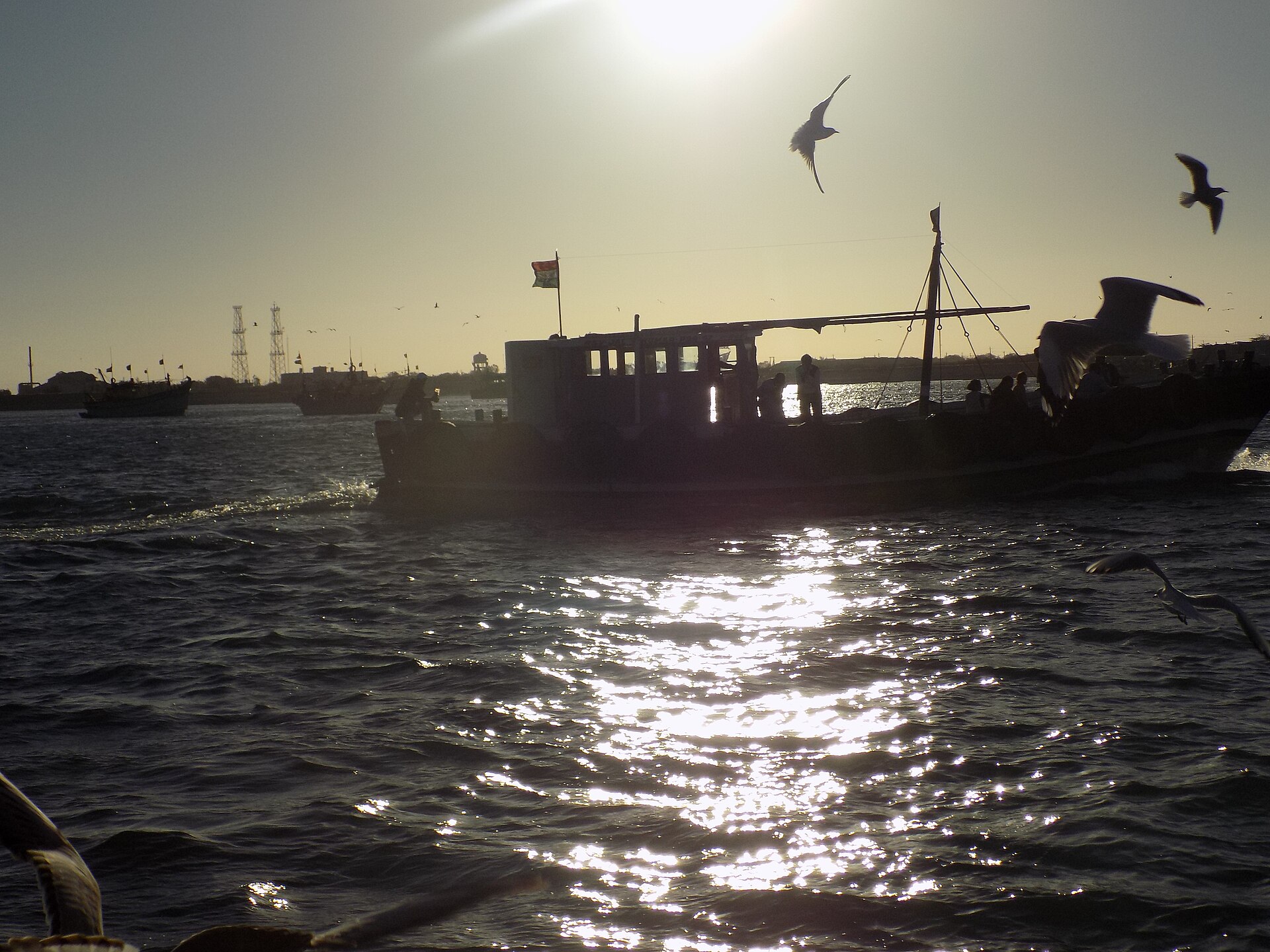
From 1983 to 1990, the Marine Archaeology Unit of India's National Institute of Oceanography dived off Dwarka and Bet Dwarka. concluded that the evidence showed a city-state with satellite towns 'in 1500 B.C.'. He judged it reasonable to call this the Dvaraka of the Mahabharata. Pottery from an onshore wall at Bet Dwarka gave a date of 1528 BCE.
Later work at the same institute read the sea floor differently. In 2004, and colleagues described offshore stones that appear to be the remains of an ancient jetty. The types of stone anchor, they wrote, show Dwarka was an important port since the historical period.
By 20 February 2025 the 's underwater wing was back, with five archaeologists led by . Its excavation at Bet Dwarka, begun in December 2025, found layers about 2,200 to 2,300 years old, with fragments of imported amphorae. 'Our focus is to determine the antiquity of the Okha Mandal region,' Tripathi said. The report of that phase says nothing about Krishna.
DisputedThe stones off Dwarka: what are they?Are the remains at Dwarka and Bet Dwarka the Mahabharata's city?
S. R. Rao, NIO Marine Archaeology Unit, 1983–90
A city-state with satellite towns 'in 1500 B.C.', reasonably identified as the Dvaraka of the Mahabharata. Pottery at Bet Dwarka dated by thermoluminescence to 1528 BCE.
A. S. Gaur and colleagues, NIO, 2004
Offshore stones appear to be an ancient jetty; anchor types show an important port since the historical period.
ASI Underwater Archaeology Wing, 2025–26
Bet Dwarka layers about 2,200–2,300 years old, with imported amphorae. Aim: 'to determine the antiquity of the Okha Mandal region'.
Where it stands: The structures are real and the coast has been settled for a very long time. No published finding confirms Krishna's city.
✓Answered: What have divers, archaeologists and satellites actually found at Dwarka and Ram Setu?
Ram Setu is a real 48-kilometre chain of shoals, and the official science says nature made it.
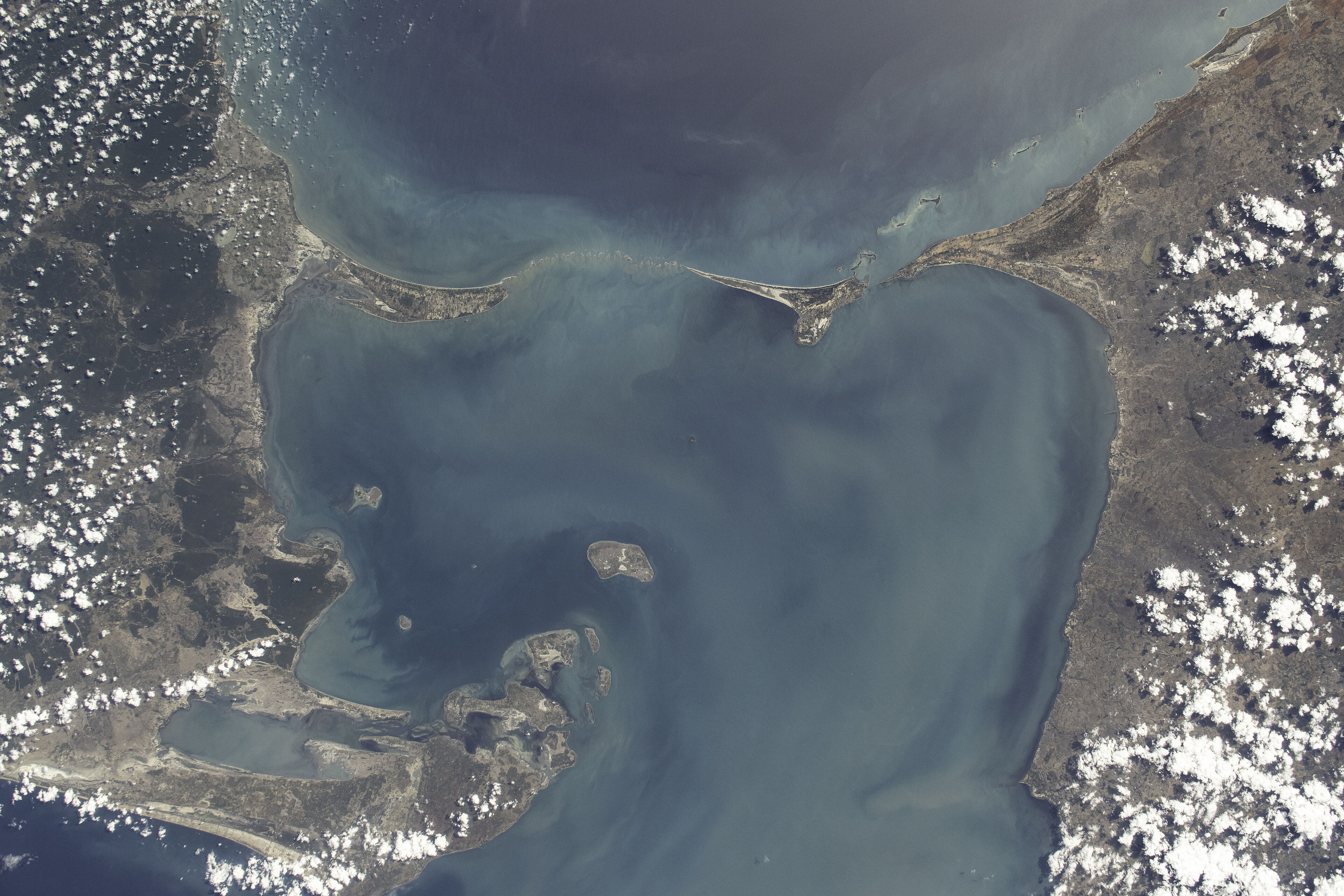
Between India and Sri Lanka runs a 48-kilometre chain of limestone shoals. Devotion knows it as . In the Ramayana, Rama's monkey allies Nala and Nila build a bridge to Lanka.
Geological evidence suggests it was once a land connection. Records at the Ramanathaswamy Temple suggest violent storms broke the link in 1480. In July 2024, scientists at ISRO's remote-sensing centres published a seafloor map built from NASA's ICESat-2 laser satellite. They describe the bridge as 'a submarine continuation of Dhanushkodi and Talaimannar Island'. About 99.98% of it lies under shallow water.
On how it formed, the official findings line up. An ASI report found 'no evidence for the structure being anything but a natural formation'. In December 2022, a government minister told Parliament that satellite images 'cannot provide direct information about the origin and age' of the structure.
DisputedRam Setu: built or formed?Is Ram Setu a built bridge or a natural formation?
The Ramayana and devotion
Rama's allies Nala and Nila built it to reach Lanka. Petitioners seek national-monument status for its religious and historical significance.
Geology, ISRO (2024) and the ASI
A 48 km chain of limestone shoals, once a land link, now 'a submarine continuation of Dhanushkodi and Talaimannar Island'. The ASI found no evidence it is anything but natural.
Government of India, December 2022
Satellite images 'cannot provide direct information about the origin and age' of the structure.
Where it stands: Every scientific finding we found describes a natural formation. Its religious status is a separate question, now before the Supreme Court.
The dates matter now because faith, heritage law and a shipping canal all run through them.
In 2005 India approved the canal, whose route needed dredging through Ram Setu. In 2007 the ASI told the Supreme Court that Rama was 'a mythical character'. After protests, the government withdrew that affidavit. In 2018 it told the court it would not touch Ram Setu and would look for another route.
The fight is now about status. wants the Centre to decide on declaring Ram Setu a national monument. The Supreme Court issued notice on his plea on 29 August 2025. A hearing on 7 May 2026 was adjourned to the third week of July. We found no report of what happened then.
The digs carry the same charge. At Bahaj in Rajasthan, the ASI officer leading an excavation near Govardhan Hill said in 2024 that it was 'too early to link' its Iron Age pottery with the Mahabharata period. Senior ASI officials told ThePrint that the government is keen to find solid proof of that period. One, who did not want to be named, said: 'funding is not a problem'.
Timeline
Ancient dates in modern India
2005 – December 2022
Sethusamudram canal approved; route needs dredging through Ram Setu
ASI tells Supreme Court Rama was 'a mythical character'; affidavit withdrawn
Government tells court it will not touch Ram Setu
Minister: satellites cannot date the shoals' origin
3 October 2023 – 20 February 2025
Supreme Court declines a separate plea to declare Ram Setu a national monument
ASI at Bahaj: 'too early to link' its pottery with the Mahabharata
ISRO scientists publish undersea map of Ram Setu
ASI underwater wing reported back at work off Dwarka
April 2025 – 7 May 2026
Gita and Natyashastra manuscripts join UNESCO's register
Supreme Court issues notice on Swamy's Ram Setu plea
ASI begins first large excavation at Bet Dwarka
Ram Setu hearing adjourned to the third week of July
6 November 2026 – 6 November 2026
Birch-bark Mahabharata at BORI reported added to UNESCO's Asia-Pacific register
This chapter settles why a 700-verse dialogue became the tradition's best-known scripture, and what 'so indeed it was' claims.
With the armies drawn up, Arjuna loses the will to fight, and the Gita begins.
Inside the Mahabharata's sixth book, the Bhishma Parva, sit 700 verses in 18 chapters: the Bhagavad Gita. In the manuscript numbering they fill chapters 23 to 40 of one section of that book.
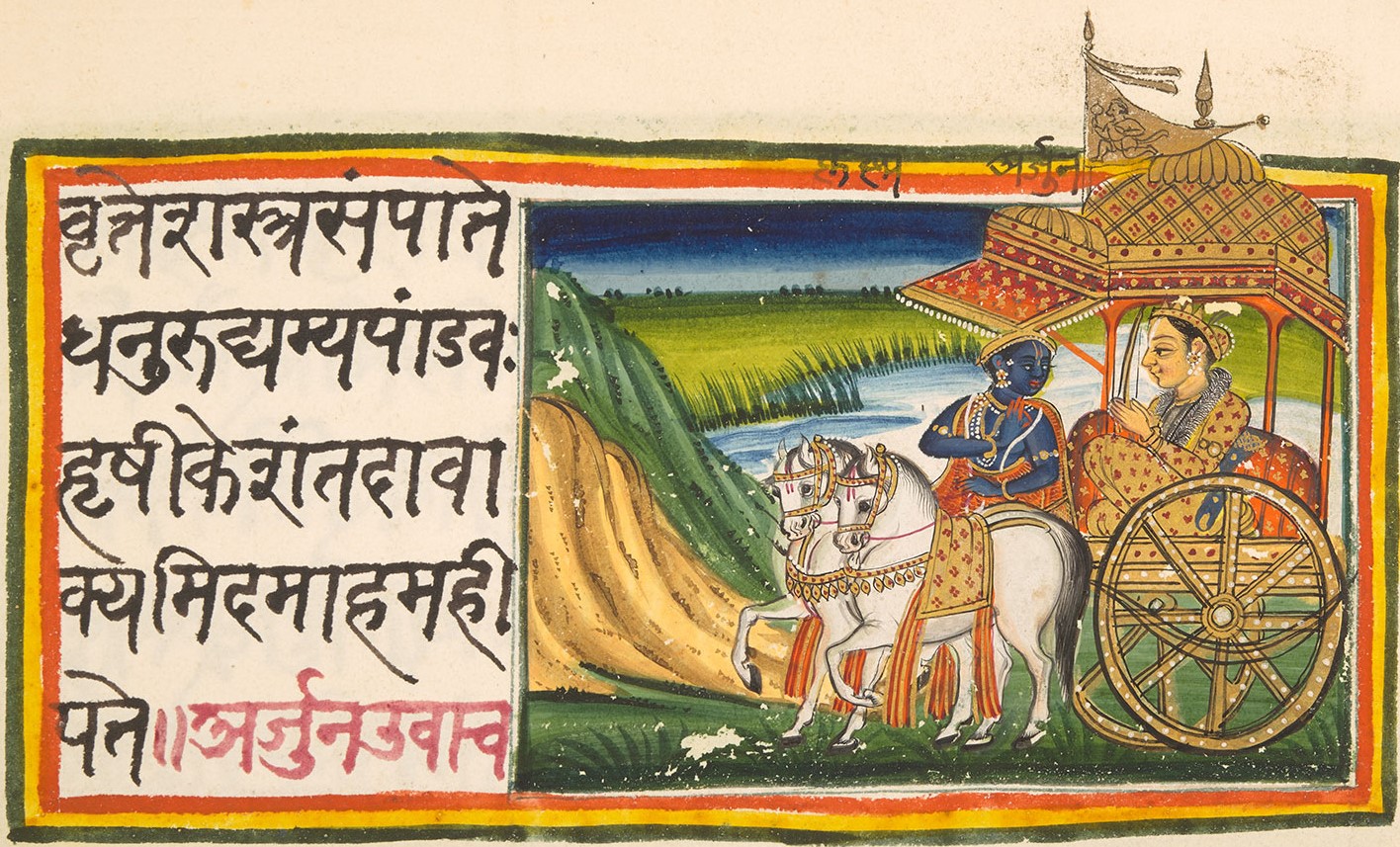
The setting is the worst possible moment for philosophy. Two armies face each other at . The warrior sees kinsmen and teachers on the other side and loses the will to fight. His charioteer is , presented as an of Vishnu. What Krishna says to him is the Gita.
When was it composed? It is generally dated to the 2nd or 1st century BCE, with estimates running from the 5th century BCE to the 1st century CE. Tradition credits Vyasa. Scholars mostly treat it as the work of several authors.
By the numbers
A short scripture inside a long epic
700verses
18chapters of dialogue
Book 6the Bhishma Parva of the Mahabharata
2nd–1st c. BCEits usual date; estimates run 5th c. BCE to 1st c. CE
✓Answered: Why did a 700-verse conversation on a battlefield become the best-known Hindu scripture?
Krishna answers with three paths to one freedom: action, devotion and knowledge.
The Gita blends older strands: Vedic duty, the yoga and knowledge of , and devotion. Out of them come three paths.
, the path of action: act without attachment to the rewards.
, the path of devotion to Krishna as a personal god. One scholar calls it 'both the easiest and the highest path to salvation'.
, the path of knowledge: discerning the true self. The Gita describes it as steep and difficult.
That breadth made it one of the , the three founding texts of Vedanta. wrote the oldest surviving commentary, around 800 CE. Ramanuja and Madhva followed with very different readings. called it his 'spiritual dictionary'. He wrote a Gujarati commentary on it in Yeravada jail in 1929.
Side by side
Three paths to the same freedom
Karma yoga
Bhakti yoga
Jnana yoga
The path of
Action
Devotion
Knowledge
What it asks
Act without attachment to the rewards
Love and surrender to Krishna as a personal god
Discern the true self
How it is described
Taught in chapter 3 and elsewhere
'Both the easiest and the highest path'
Steep and difficult
The frame may be story and the content is instruction, and that tension is the point.
The Gita's first verse calls Kurukshetra the 'field of dharma'. Many scholars read the battlefield as 'an allegory for the struggles and vagaries of human life'. Recall the evidence on the epics. A real conflict is possible, but the specific people and events are beyond proof.
Readings
Three ways to read the battlefield
1Argued
An allegory of the struggle inside every person
The caseThe first verse calls the battlefield the 'field of dharma'. Many scholars read it as 'an allegory for the struggles and vagaries of human life'.
The counterThe epic calls itself itihasa, 'so indeed it was', and the tradition treats it as an account of past events.
2Argued
A real place and a real war
The caseKurukshetra is a real place in the Kuru heartland, and wars among clans of that age are attested.
The counterWhether this war happened 'cannot be proved or disproved', and the Gita itself is dated centuries after any plausible war.
3Our reading
Both: a story frame around instruction
The caseThe dilemma of acting rightly when every act has a cost is real whether or not the battle happened.
The counterThis is a reading, not a finding; it sidesteps the historical question rather than answering it.
'So indeed it was' is a claim about the past, but the tradition used these stories to open scripture to everyone.
The epics are , from iti ha asa, 'so indeed it was'. On its face that is a claim of history. The tradition treats the itihasa and Puranas as authoritative accounts of past events.
Yet the Chandogya Upanishad calls 'the corpus of histories and ancient tales' the , in Patrick Olivelle's translation. The name mattered because the first four were guarded. The Bhagavata Purana says the Mahabharata was composed out of mercy for women, labourers and others who could not hear the Vedas.
The original article adds that teachers in the tradition often read itihasa more fully, as what was, is and will be. We could not find that reading in the sources we opened.
Side by side
Two ways to hold the past: the line and the wheel
The line: modern history
The wheel: the yuga cycle
Shape of time
A one-way arrow
Ages that decline and return
An event
Happens once, then recedes
A pattern that recurs
The test of a story
Did it happen, on a datable day?
Does it keep happening?
The original article's contrast. The 'wheel' reading of itihasa is its claim, which we could not confirm in our sources; cyclic time itself is well attested in the yuga doctrine.
✓Answered: Why do the Puranas count time in billions of years, and why do they shape daily Hindu life more than the Vedas?
This chapter settles why the Puranas count time in billions of years and how they came to shape everyday Hindu life.
Puranic time runs in four ages that shrink in the ratio four, three, two, one.
If the epics are where fact and story blur, the are where the tradition stops keeping time the way we do. Its cycle runs through four ages of falling virtue, in the ratio 4:3:2:1. The Krita or Satya age lasts 1,728,000 years. Treta lasts 1,296,000, Dvapara 864,000, and Kali 432,000.
The scheme is older than any one Purana. The Mahabharata and the Manusmriti describe the same decline. The four ages together make 12,000 'divine years', each of 360 human years.
We live in the . By the tradition's count, 5,127 years of it have passed as of 2026, and 426,873 remain. That is about 1.2% of the way through. Not everyone keeps this count. The 20th-century teacher Sri Yukteswar proposed a 24,000-year cycle instead and called the 432,000-year figure a miscalculation.
Chart
Four ages, each shorter than the last
Krita or Satya Yuga1728000years
Treta Yuga1296000years
Dvapara Yuga864000years
Kali YugaThe current age: 5,127 years elapsed as of 2026432000years
The 4:3:2:1 ratio of the yuga cycle. We live in the last age.
A single day of Brahma lasts 4.32 billion years, and it was never meant to be checked.
Zoom out. One full cycle of four ages, a , lasts 4,320,000 years. Seventy-one of them make a , the reign of one Manu. A thousand make a , 4.32 billion years: a single day of the creator god . Brahma lives a hundred years of such days, and by this count we are about halfway through his life.
By the numbers
Zooming out: from one age to a day of Brahma
4,320,000years in one mahayuga, all four ages
71mahayugas in a manvantara, the age of one Manu
4.32 billionyears in a kalpa: one day of Brahma
426,873years of the Kali Yuga left, as of 2026
Devotional reckonings of time, not historical dates.
This loops back to the two clocks. Set against a day of 4.32 billion years, the quarrel between 3102 BCE and 836 BCE for a war looks very small.
A Purana is a genre, not a book, and no Purana has a single date.
'Purana' means old. Tradition counts eighteen great Puranas, the , and a similar number of lesser . Even the list of eighteen sometimes grows to twenty. For the lesser ones, wrote, 'we don't have a consistent list'.
Dating them is hard. Their first versions were likely composed between the 3rd and 10th centuries CE. As two scholars put it, 'no Purana has a single date of composition'. A UCLA overview stretches the span wider, from the 4th century BCE to about 1000 CE.
By their own definition, a Purana covers five topics, the . No single Purana treats all five in detail. The Vishnu Purana comes closest.
How it fits together
A Purana's five marks
Pancha-lakshanathe five defining topics
Sarga creationPratisarga dissolution and renewalVamsa genealogiesManvantara the ages of the ManusVamsanucarita royal dynasties
The tradition's own definition. No single Purana covers all five in detail; the Vishnu Purana comes closest.
How tradition sorts the eighteen by quality
Tradition also sorts the eighteen Mahapuranas into three groups of six by , or quality, and by the god each exalts most: Vishnu, Brahma or Shiva. The UCLA overview calls the scheme 'inadequate', since no Purana is devoted only to Vishnu or Shiva. Debroy called it 'somewhat artificial'. As he put it, 'all three feature in every Purana'.
A traditional grouping that scholars call inadequate or artificial: every Purana features all three gods.
The Puranas gave a civilisation its goddess texts, its temple lore and its rites for the dead.
The Puranas are vast and encyclopedic. The Markandeya Purana contains the Devi Mahatmya, one of the most important texts of Goddess worship. The Skanda is the largest, with about 81,000 verses. The second part of the Garuda Purana deals with death, cremation and the soul's journey after death.
The Vishnu Purana is cited in the Sri Vaishnava tradition as 'the gem among Puranas'. In 1840 it became the first Purana to be translated and published. Its date is as contested as any: estimates run from 400 BCE to 900 CE.
Side by side
Puranas that shape daily life
Centred on
Why it matters
Markandeya
The Goddess
Contains the Devi Mahatmya, one of the most important texts of Goddess worship
Skanda
Shiva's world
The largest Purana, about 81,000 verses
Garuda
Death
Its second part covers cremation rites and the soul's journey
Vishnu
Vishnu
Closest to the five-mark definition; 'the gem among Puranas'; first translated, 1840
This chapter settles what Advaita Vedanta claims, who built it, and why a modern sage closes the shelf.
Advaita makes its case in four moves, and the last says you were never anywhere else.
takes its name from 'not-two'. It builds the Upanishads' great sayings into a system. It can be stated in four moves.
First, only is ultimately real. Second, the world of many things is , an appearance of Brahman rather than a separate reality. Third, the self is not different from Brahman. Fourth, liberation, , comes when knowledge of Brahman dawns and , ignorance of one's true identity, is removed.
Side by side
Advaita in four moves
What Advaita claims
1. Reality
Only Brahman is ultimately real.
2. The world
The world of many things is maya: an appearance of Brahman, not a separate reality.
3. The self
The self is not different from Brahman.
4. Liberation
Moksha comes with knowledge of Brahman, which removes avidya, ignorance of one's true identity.
Advaita means 'not-two'. Each move follows from the one before.
On this view, that knowledge needs no striving to produce it. You are not travelling toward a summit. You are recognising where you already stand. Not every school agrees. Ramanuja's school reads 'thou art that' as a relation, not an identity, and Madhva's reads it as 'thou art not that'.
Shankara built the school, and his dates split by more than a thousand years.
The man credited with turning this into a school is . His accepted works include commentaries on the Brahma Sutras, the principal Upanishads and the Gita. More than 300 texts carry his name, but most are not considered authentic.
Here the two clocks return. Scholars of the late 19th and early 20th centuries dated him to 788–820 CE. Current scholarship prefers about 700–750 CE. The Advaita monasteries place him in the 5th century BCE, with birth years from 509 to 483 BCE. The account has him attaining union with Brahman in his 32nd year, in 476 BC.
Even the famous four monasteries are uncertain. Hagiographies from the 14th century onward credit him with founding them. The historian Paul Hacker suggested that a 14th-century figure, Vidyaranya, may have founded one and attributed it to Shankara. Shankara was probably little known in his own lifetime.
DisputedWhen did Adi Shankara live?
The Advaita monasteries
5th century BCE: birth years from 509 to 483 BCE; Kanchi gives his death as 476 BC, in his 32nd year.
Late 19th- and early 20th-century scholars
788–820 CE.
Current scholarship
c. 700–750 CE, bounded by the authors he debates and the earliest commentary on his work.
Where it stands: Scholars place him in the first half of the 8th century CE. The monasteries' date is more than a thousand years earlier.
One philosopher, dated across more than a thousand years.
Ramana's whole method fits in one question: who am I?
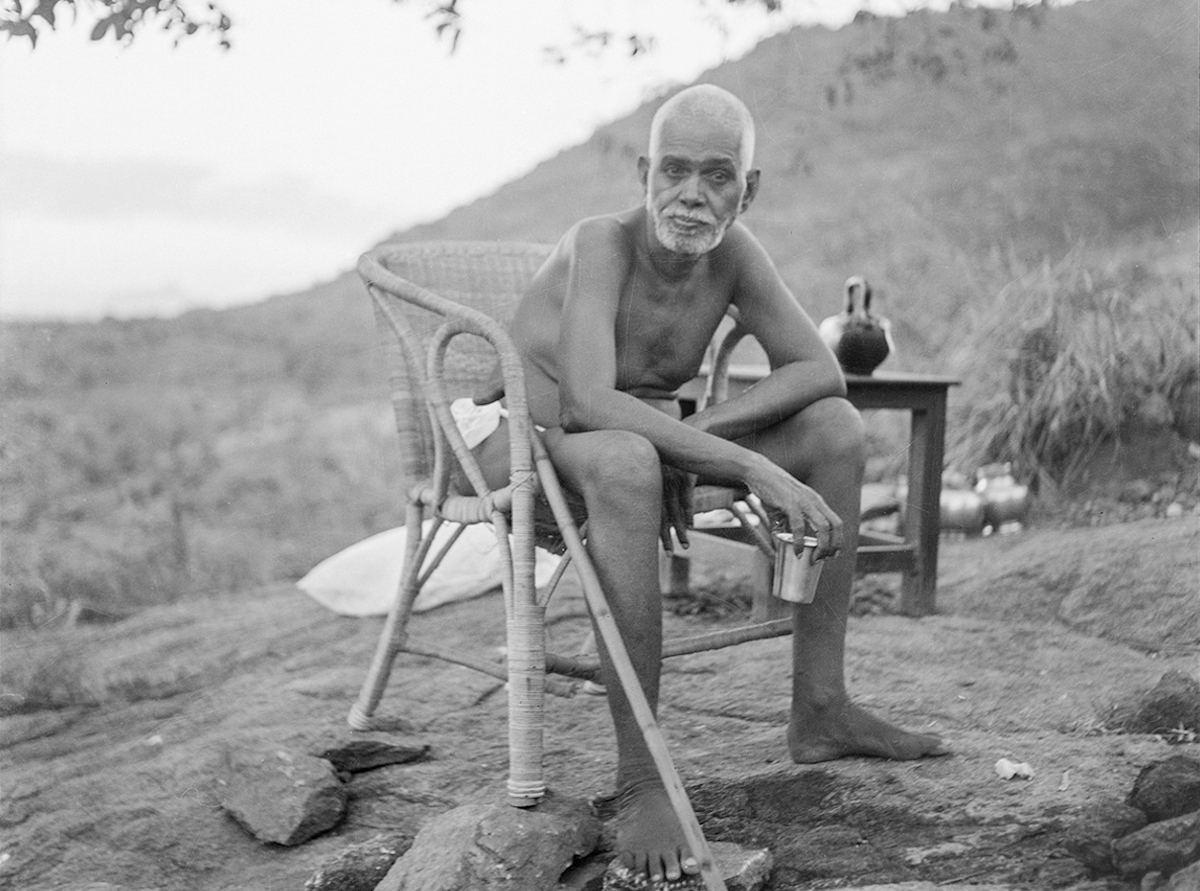
was born on 30 December 1879 at Tiruchuli in Tamil Nadu. After reaching the hill in 1896, he lived for years on its slopes. From 1899 he stayed mostly in Virupaksha Cave, for 17 years, and from 1916 at Skandashram. From 1922 until his death he lived in the ashram that grew up around his mother's tomb. He named no human teacher. The hill itself is listed as his guru.
In about 1902 a visitor, Sivaprakasam Pillai, put questions to him. The answers were published in 1923 as Nan Yar?, 'Who am I?'. The method is . You set aside each thing you are not: the body, the senses, the mind. When other thoughts arise, you ask: 'To whom do they arise?'
Of all the thoughts that arise in the mind, the 'I' thought is the first.Ramana Maharshi, Who am I?
How it fits together
Self-enquiry: tracing 'I' to its source
Not thisset aside, one by one
The bodyThe sensesThe mind
↓ set aside
'To whom do they arise?'asked of every passing thought
↓ turn back
The 'I' thoughtthe first of all thoughts
Nan Yar?'Who am I?' in Tamil
↓ trace
Its sourcewhere the enquiry ends
As set out in Who am I?, from answers given around 1902.
In Ramana the 3,500-year line becomes a documented person, and even then a legend starts to grow.
Set him beside Shankara. Shankara's dates are split across twelve centuries. Ramana's are not split at all. He was photographed and written about to the end, and visitors filed past his room for a final glimpse. He died at 8.47 pm on 14 April 1950.
And yet. At the time of his death a shooting star was seen, and some devotees took it as a sign. Even around a life documented to the minute, the second lens, story, begins its work.
Timeline
A life documented to the minute
30 December 1879 – 1 September 1896
Born Venkataraman Iyer at Tiruchuli
Sudden fear of death; asks what it is that dies
Arrives at Tiruvannamalai
February 1899 – 1916
Moves onto the hill; mostly in Virupaksha Cave for 17 years
Answers Sivaprakasam Pillai's questions: 'Who am I?'
Moves to Skandashram
1922 – 14 April 1950, 8.47 pm
Settles at the ashram around his mother's tomb
Who am I? first published
Dies at the ashram
Keep one line straight. The record documents the life: the dates, the hill, the visitors. The inner recognition at sixteen is something he reported. Whether it holds is the experiment he invited others to run.
Two teachers, two clocks
Side by side
Two teachers, two clocks
Adi Shankara
Ramana Maharshi
The tradition's clock
5th century BCE
1879–1950
The historian's clock
c. 700–750 CE
1879–1950
What we have
Commentaries; a life told by later hagiographies
Photographs, records, visitors' accounts
09Ask the question it was built to answer
This chapter settles how to read each kind of text without forcing it into the wrong test, and what to watch next.
Plot the whole shelf on two axes, and one corner holds a single man.
Stack the shelf on two axes. One asks how much real-world grounding a text has. The other asks how far it reaches past describing the world, toward changing the reader.
Side by side
Fact, story or instruction? The shelf on two axes
Little historical grounding
Stronger historical grounding
Aimed at inner change
Upanishads · Bhagavad Gita · Advaita Vedanta
Ramana Maharshi
Story, ritual or record
Puranas · Vedic hymns
Ramayana · Mahabharata
An interpretive placement from the original article, not a measurement.
Along the bottom sit the Vedic hymns, the epics and the Puranas. They touch the historical world, so this is where the fact-or-fiction argument lives. Higher up sit the , the Gita and , with little historical hook and little need of one. Alone in the upper corner sits , whose life is fully documented.
The cast sorts the same way. and are traditional authors; Valmiki even appears in his own epic. Rama is worshipped as the seventh avatar of Vishnu. For the tradition, Krishna's death opens the Kali Yuga. Shankara is historical but dated across twelve centuries. Ramana is documented to the minute.
Who is who, by kind of being
Side by side
Who is who, by kind of being
Who they are
Kind
Note
Vyasa
Traditional author of the Mahabharata
Traditional
Scholars see the epic as the work of many hands
Valmiki
Traditional author of the Ramayana
Traditional
Appears in the opening of his own epic
Rama
Prince of Ayodhya
Epic hero, worshipped as divine
Seventh avatar of Vishnu
Krishna
Arjuna's charioteer, speaker of the Gita
Epic hero, worshipped as divine
His death opens the Kali Yuga in the tradition
Adi Shankara
Philosopher of Advaita
Historical
Dated c. 700–750 CE, or the 5th century BCE
Ramana Maharshi
Sage of self-enquiry
Historical, 1879–1950
Fully documented and photographed
Most arguments about these texts come from jamming three measuring sticks together.
The fact-or-fiction question is a good way into this material and a poor way to leave it. The texts are not above scrutiny. Most were simply built to do something other than report events.
In the original article's framework, three measuring sticks need to stay apart. The first is what a text claims: a war, a bridge to Lanka, a self identical with the absolute. The second is what scholarship can check: when a text was composed and how it grew. The third is what a text is for: ordering a ritual, carrying a moral world, kindling devotion, or prompting a recognition.
Side by side
Three measuring sticks to keep apart
What it measures
Example on this shelf
What a text claims
The internal story
A war at Kurukshetra, a bridge to Lanka, a self identical with the absolute
What scholarship can check
When a text was composed and how it grew
The Rigveda's hymns are roughly a thousand years older than the Gita
What a text is for
The job it was made to do
Order a ritual, carry a moral world, kindle devotion, prompt a recognition
The original article's framework.
The literalist collapses the third stick into the first. That goes for the devotee defending every detail and the sceptic debunking it. Scholarship can tell you the Rigveda's hymns are roughly a thousand years older than the Gita. It cannot tell you whether 'thou art that' is true.
The tradition's own filing already respects this. The heard Veda is authorless by definition, so beyond historical checking. The remembered texts are openly human and plural.
Ask each text the question it was built to answer, and watch the digs, the courts and the festival.
So the honest posture is to ask each text the question it was built to answer. Read the Vedas as liturgy. Read the epics as itihasa, story grown over a real world. Read the Puranas as devotional cosmology in deep time. Read the Upanishads, the Gita and Advaita as instruction, tested not in a library but in a life.
Side by side
Ask each text the question it was built to answer
Read it as
The Vedas
Liturgy
The two epics
Itihasa: story grown over a real world
The Puranas
Devotional cosmology in deep time
Upanishads, Gita, Advaita
Instruction, tested in a life
The original article's suggested reading posture.
What you now know.
The tradition files its texts as heard or remembered, not as history or myth.
What to watch. From 5 to 25 December 2026, Kurukshetra hosts the International Gita Jayanti Mahotsav. For the first time, major cultural events move to Jyotisar, which organisers call the Gita's birthplace. The Supreme Court has yet to decide Swamy's Ram Setu plea, as far as we could find. The ASI says it is planning wider, deeper offshore work at Dwarka and Bet Dwarka.
Timeline
What to watch
International Gita Jayanti Mahotsav opens in KurukshetraMajor cultural events at Jyotisar for the first time
Main festival events
Festival closes
Supreme Court on Swamy's Ram Setu plea
ASI's next offshore phase at Dwarka and Bet Dwarka
The question we left open. Advaita is one among several. Vishishtadvaita and Dvaita read the very same words differently. How they do it, and what changes when they do, is yours to chase.
You made it
What you now know
The 10 questions this story set out to answer, in one line each.
Are these texts history, fiction or something else, and how does the tradition itself sort them?
Each can be read as fact, story or instruction. The tradition sorts them by how they arrived: shruti, 'heard' and authorless, and smriti, 'remembered'. It calls the epics itihasa, 'so indeed it was'.
Why do the tradition's dates and the historians' dates differ by thousands of years?
The tradition counts in cosmic ages anchored on a Kali Yuga that began in 3102 BCE. Historians date texts by language, archaeology and outside references, which puts the Kuru world around 1200–800 BCE. The gap closes to nothing only for Ramana Maharshi, 1879–1950.
How did hymns more than 3,000 years old survive almost word for word, mostly without writing?
By recitation learned from childhood with accent-based techniques, word-by-word and joined-up forms. The oldest surviving Rigveda manuscripts date only to about 1040 CE.
What did the Upanishads claim when they turned from ritual to the self, and does everyone agree on what they meant?
That Brahman, the ground of everything, and Atman, the self, are one: 'thou art that'. Advaita reads that as identity; Vishishtadvaita as relation; Dvaita reads it as a denial. Even the translation is argued.
Did the Mahabharata war happen, and were Rama and Krishna real people?
Unknown. The places and an Iron Age Kuru kingdom are real; the war 'cannot be proved or disproved' (Upinder Singh). Astronomical datings range from 3143 to 1198 BCE. No independent evidence exists either way for Rama or Krishna as individuals.
What have divers, archaeologists and satellites actually found at Dwarka and Ram Setu?
Real stone structures and anchors off Dwarka, dated by S. R. Rao to about 1500 BCE but read by later NIO work as a historical-period port; the ASI's 2025–26 dig found layers about 2,200–2,300 years old. Ram Setu is a 48 km chain of shoals that ISRO maps as a submarine continuation of the two coasts; the ASI found no evidence it is anything but natural.
Why do these ancient dates still reach Parliament and the Supreme Court, and who wants what from them?
Because faith, heritage law and infrastructure run through them: a canal that would dredge Ram Setu, a plea to make it a national monument, state-funded digs at epic sites, and UNESCO nominations prepared by a government centre.
Why did a 700-verse conversation on a battlefield become the best-known Hindu scripture?
It braids duty, knowledge and devotion into three paths to one freedom, became one of Vedanta's three founding texts, and drew commentary from Shankara, Ramanuja, Madhva and Gandhi. It is generally dated to the 2nd or 1st century BCE.
Why do the Puranas count time in billions of years, and why do they shape daily Hindu life more than the Vedas?
Their yuga cycle nests ages of up to 1.7 million years inside a 4.32-billion-year day of Brahma: a theology of scale, not a chronology. As the 'fifth Veda', the epics and Puranas were open to people barred from the four Vedas, and they carry the gods, goddess texts and death rites people live with.
Who was Ramana Maharshi, and why does a 3,500-year story end with a man who died in 1950?
A Tamil sage, 1879–1950, who after a fear of death at sixteen lived on the hill of Arunachala and taught self-enquiry, 'Who am I?'. He is the one figure both clocks date the same way: documented, yet purely spiritual in what he taught.
What this story could not settle, and why. Each item is something not known yet, a claim we couldn't confirm, something nobody publishes, or something we checked and left out.
Claimed, not confirmedLeft out
Not known yet 3 things can't be known until they happen. They're in What to watch next, just below; the story updates when they land.
Claimed, not confirmedattributed in the text and marked unconfirmed
Where the Vedic Foundation's 3138 BCE date for the war comes from
Wikipedia's page on Puranic chronology lists 3138 BCE as one entry in the Vedic Foundation's chronology, and we could not trace what that chronology bases it on. The original article credited the date to IGNCA, but the IGNCA page it cited does not contain it.
What we could confirm: The common traditional anchor is the start of the Kali Yuga in 3102 BCE, worked back from the astronomer Aryabhata in 499 CE; the Aihole inscription of 634 CE implies 3101 BC.
Who first dated the war's start to 22 November 3067 BCE
A popular chronology by Stephen Knapp credits a Professor Raghavan with this date. We could not see Raghavan's own work, so the attribution rests on Knapp alone.
What we could confirm: B. N. Narahari Achar also arrived at 3067 BCE, according to IGNCA's report of the 2003 colloquium and Wikipedia.
Whether the remains off Dwarka are the Mahabharata's Dvaraka
After the 1983–1990 excavations, S. R. Rao concluded the evidence showed a city-state of about 1500 BCE and judged it reasonable to call it the epic's Dvaraka; that date rests on carbon dating of one piece. We found no named archaeologist rebutting him directly, so we set his reading against later work from his own institute.
What we could confirm: A 2004 study from the same institute reads the offshore stones as an ancient jetty, a port since the historical period (we read only its abstract). The ASI's Bet Dwarka dig, reported in May 2026, found layers about 2,200–2,300 years old, and its report says nothing about Krishna.
Whether teachers read itihasa as 'what was, is and will be'
The original article says teachers in the tradition often read itihasa this way. We could not find that reading in any source we opened, so the story gives it only as the article's claim.
What we could confirm: Itihasa comes from iti ha asa, 'so indeed it was'. The tradition treats the epics and Puranas as authoritative accounts of past events and also calls them a fifth Veda.
Radiocarbon dates of about 800–350 BCE for the epic's archaeological layer
The original article said radiocarbon dates on the relevant archaeological layer run from about 800 to 350 BCE. We could not find that figure in any source, so we dropped it.
What we could confirm: The Painted Grey Ware culture behind the epic's places is conventionally dated about 1200 to 600–500 BCE; Asko Parpola puts the war in its late phase, about 750 to 350 BCE.
Reciting the hymns forwards and backwards as a check on errors
The original article described forwards, backwards and checksum-like recitation patterns. The reference page we read on the Rigveda does not describe them, so the story covers only the methods it does.
What we could confirm: One recited form isolates every word and another joins the words by the rules of sound; UNESCO says the techniques rest on tonal accents and aim to keep the sound of each word unaltered.
Some reports call the manuscript UNESCO listed in November 2026 '400 years' old, but ThePrint's report, which we relied on, gives no age, so we left the figure out.
What we could confirm: Georg Bühler acquired the fragmentary manuscript in Kashmir in 1875, and UNESCO calls it 'the most authentic extant representative of the old Kashmiri version'.
That the Matsya is the oldest Purana and the Bhagavata dates to the 9th–10th century
The original article made both claims; the sources we read supported neither, so we removed them.
What we could confirm: The reference account we used names the Brahmanda as one of the earliest Puranas and says dates for the Bhagavata vary widely; two scholars it quotes say no Purana has a single date of composition.
That the young Ramana lay down and imagined his body dying
The original article took this detail from Britannica, which we could not open, so the story tells the 1896 experience only as Wikipedia and the ashram's sources do.
What we could confirm: In July 1896, at sixteen, he was seized by a fear of death and asked what it is that dies.
When any of these closes, we publish a new version and mark exactly what changed.
What to watch next
International Gita Jayanti Mahotsav opens in Kurukshetra (to 25 December)
Major cultural events move to Jyotisar, which tradition calls the Gita's birthplace, for the first time.
Supreme Court on Subramanian Swamy's Ram Setu plea
Listed for the third week of July 2026; we found no report of an outcome. A ruling or a Centre decision would settle Ram Setu's legal status, not its origin.
The ASI's next offshore phase at Dwarka and Bet Dwarka
The first dated results came from onshore layers about 2,200–2,300 years old. Offshore results could test Rao's 1500 BCE reading.
Published reports from the Bahaj excavation in Rajasthan
The dig's leader said it was 'too early' to link its finds to the Mahabharata; a formal report would show what the evidence supports.
Was this worth your time?
Tell us, and see what other readers said.
Follow this story
Get an email when this story changes. Nothing else.
How this story was made
Carefully crafted by people and AI. AI agents search widely, read the sources and draft the story; a person chooses the subject, shapes and edits it, and decides when it's ready to publish. Every source is listed below, with what was read in full and what we couldn't settle.
Where the facts come from. Reference works (mostly Wikipedia articles, read at length, and UCLA's overview of the Puranas), primary texts and institutions (BORI, UNESCO, the Sri Ramanasramam timeline, the text of Who am I?), a scholarly abstract on Dwarka, an IGNCA colloquium report, and news reports from 2022 to November 2026.
How this version was built. It began from Nitin Agarwal's article of 24 November 2026 and was researched again on the ten reader questions at the top of the story. Several of the article's figures were corrected against the pages it linked: the Mahabharata's bulk is now 3rd century BCE to 3rd century CE, it is 'one of' the longest poems, the Gita's usual date is the 2nd or 1st century BCE, and the IGNCA page it cited for 3138 BCE in fact reports dates from 3143 to 1478 BC.
What we couldn't open. Britannica, the World History Encyclopedia, PIB, the UN India page, Business Standard and the PubMed copy of the ISRO study blocked automated reading; where possible the same facts were read in another copy. Two PDFs (a 2004 Current Science paper and a University of Georgia teaching note) could not be decoded, so only abstracts or search summaries were used.
Interpretation. The three lenses, the two axes and the reading posture are the original article's framework and are marked as its reading wherever they appear.